Showing posts with label Sanders. Show all posts

Wednesday, March 23, 2016

Framing the presidential race

By THOMAS HARTWELL

The presidential race in any context is a media frenzy, but this race has been unlike any before it in many ways. As with any story, the media make choices as to how to approach the stories surrounding the presidential race, and there are four commonly used "frames" of presentation, all of which have been used to cover the year's campaigns.

Horse Race:


Horse race journalism in the political spectrum is the presentation of information as a contest or comparison of, in this case, presidential candidates. There's been a lot of talk about a possible convention contest for the Republican nomination this campaign season, and that has opened the door for A LOT of horse race journalism. With a race this close between Trump and Cruz and a candidate pulling delegates away from the two front-runners, many outlets are taking the opportunity to present some "who will win the sprint to 1,237?" stories. There has been some in regard to the Democrats' race as well, but with a race on the left seemingly more and more decidedly won by Hillary, there have been more stories about the change that Sanders' campaign has brought to politics than "who will win?"
From the Associated Press
Conflict:

Horse race and conflict presentation of the Republican race have gone hand-in-hand this campaign season. As the race has continued and candidates have dropped out, there has been more opportunity for conflict-frame journalism. For instance, this CNN article incorporates elements of the delegate race, but describes the race for the nomination between Trump and Cruz as a "duel." A search for stories about Trump on CNN and other news outlets provides a look at the presentation of Trump's campaign strategy: conflict frame and a "Trump vs..." mentality. 

From cnn.com search

Issues:

Candidates of the same party and especially opposite parties LOVE to slam each other on policy issues -- the presidential race produces plenty of these opportunities. While most attacks come on an opponent's stance on ongoing issues, current events also play a part. For example, Trump and Cruz chose to slam President Obama on immigration regulations and international terrorism in response to terrorist attacks in Brussels, Tuesday. Stories written on the issues provide voters and onlookers with the ability -- hopefully objectively, but we all know, not so much -- to make decisions based on those issues. Trump has also generated lots of attention and media spotlight for himself by making large and outrageous issue claims. He's actually winning in the presidential race on lots of the "important issues," because he has so much coverage out there on his policy on those issues.

From msnbc.com
Candidate Attributes:

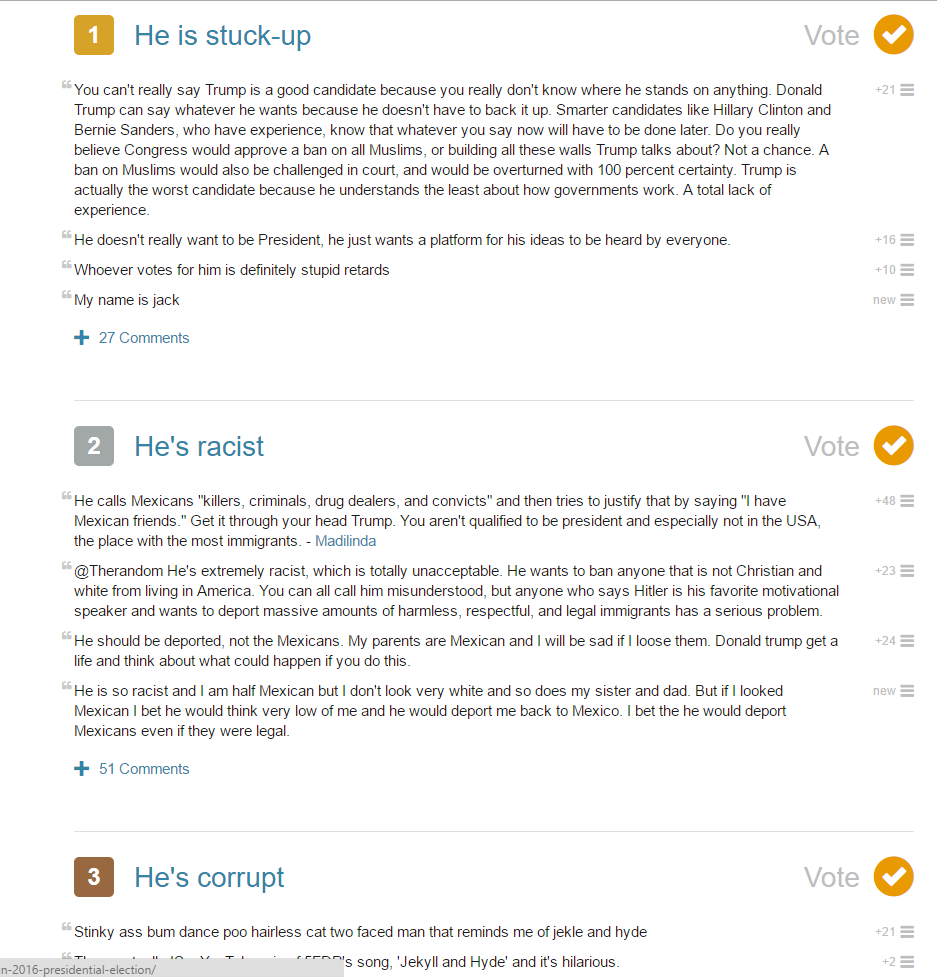
Another frame of media coverage dominated by Donald Trump and, some may argue, Bernie Sanders. Trump and Sanders' revolutionary approach to U.S. politics has changed the race for good, and a lot of that focuses on their personal attributes. Plenty of stories have focused on Trump's deficiencies, outlining why he couldn't, shouldn't or wouldn't be President of the United States.
From toptens.com
This article even outlines ten reasons why Donald Trump should not be the next president, citing his past words, actions, claims, etc. 

Friday, March 4, 2016

Lessons on the campaign trail

By THOMAS HARTWELL

I am so incredibly excited to be in journalism, and my number one priority and my hope is that it shows while I'm on the job and in my finished product. As I've participated in gathering information and in reporting on the campaign trail, I have learned lessons, and sured-up others.
Bernie Sanders speaks at campaign rally at Morehouse College
in Atlanta, Tuesday, February 16. Photo by Thomas Hartwell
First lesson: the devil is in the details. I've learned this the hard way previously. The campaign events and news stories that I have covered have allowed me to build off of the mistakes that I've made. Accuracy is everything in journalism, and so is integrity -- accurate quotes and assurance of permission are paramount. During interviews, I write times of reference for good quotes, passionate answers, jokes, etc. on my recordings. I also have interviewees write their names and contact information on a notepad as well as record those elements on tape. For absolute assurance of friendly relations and a happy interviewee, I have made a habit of emailing soon after the interview thanking them and requesting a response which, in writing, displays my ability to use their photos, names etc. in my stories or blog posts (I have an archive full).

A man who preferred to be called "St. Nick" and his friend,
who preferred anonymity at the Morehouse College
 Bernie Sanders event, Tuesday, February 16.
Photo by Thomas Hartwell
On that same note, a lesson that I've learned throughout my life, but that has been reinforced in my reporting: don't take people and your interactions with them for granted. I love nothing more than meeting new people, asking them about the things they love or hot-button issues and participating in a sort of dialogue. Journalism allows for a relationship to develop very quickly and last between interviewer and interviewee -- it also provides opportunities for relationships to go South quickly, but we'll put that to the side for now. These relationships with both the people interviewed and people you simply run into have the potential to impact you in the moment and benefit you down the road.


"Look like you know what you're doing and nobody asks any questions." This is a lesson that I learned early and that I apply often. Check out the story.

My research lessons are simple: 1. Make note of everything relevant to your topic; even if you feel like you have way too much information, you'll be able to make some pretty cool connections that you wouldn't have otherwise realized. 2. If someone else knows more than you on a specific topic, LEARN FROM THEM. Political science wasn't something I was entirely interested in until recently, and I have learned SO MUCH simply from listening to my colleagues.

Gabriel Ramos stands atop the media platform at the
Morehouse College Bernie Sanders event, Tuesday,
February 16. Photo by Thomas Hartwell
It is becoming increasingly clear to me how exciting my career will be and how small the world of journalism really is. I have had an absolute blast on the trail with my colleagues, and I know that the excitement of, "You got that interview?" and "There's a great angle for a shot over there" will continue and manifest itself in important professional relationships in coming months and years. Whether or not my colleagues become competition in the future doesn't matter -- we'll all be working toward a commons goal: reliable, accurate and dependable reporting that, among other things, keeps the general public informed and the elites accountable. Final lesson: don't take your colleagues for granted -- your competition might just turn out to be your saving grace in the end.

Tuesday, February 2, 2016

Campaign narratives and success of candidates

A narrative not only makes for a more interesting story and, in turn, campaign season, but also can win a candidate a state, or even a general election. There have been more than a few surprising narratives driving the candidates' campaigns already this season, and I'm sure you wouldn't be surprised to hear me say that I will, again, be mentioning the Trump (I'm sorry, but as one of my professors once said, "He's the gift that keeps on giving"). The other not-so-surprising choice for a narrative-rich campaigner, I think, is easily Sanders.

I'll start with Trump and just get it out of the way.

Trump has capitalized on two things: fear and frustration with Washington. Trump has been unapologetically blunt, crass and, at times, down-right rude. He can get away with this, and even continue to climb in the polls, because his narrative is that he is new -- he's a successful business man, not a politician, and he swears to use his hard bargaining, his CEO know-how and his tell-it-like-it-is-edness to bring his enemy to their knees and to "Make America great again." How, you ask? "Well, first things first, let's get me elected." People go for that. Partly because of Trump's story telling -- "I'm a successful business man who, like you, is fed up with Washington" -- and partly because his followers just want to see what his specific plans are finally.

Sanders tells a similar story of being fed up, but his story is a little more history and policy-based. Sanders tells us that he has been in politics since the '70s, building trust with listeners. He, like Trump, acknowledges the calls for change, but addresses the change with more specific answers that might be harder for some followers to process than a general, "It's gonna be HUGE." His largest success, though has been embodying the "little guy" who takes on the enormous establishment that is lobby groups and Super PACs. Distrust of cookie-cutter politicians makes Washington the antagonist in both of these candidates' cases and, of course, makes themselves the protagonist.