To understand confirmation bias in the media I started with two stories by Salon.
While the first piece starts out wonky, seemingly very issues-oriented, it gets
down to confirming a bias Salon readers may have, especially as we get closer
to summer (the conventions) and fall (the general election).
One paragraph starts, “Unfortunately, neither Hillary
Clinton nor Donald Trump — the two leading presidential candidates right now —
inspire much confidence that climate change will be a priority for their
administrations.”
The very next paragraph starts, “While a Clinton
presidency could likely have undesirable consequences for the environment, a
Trump presidency would almost certainly be catastrophic.”
Sen. Sanders is briefly mentioned, but the idea is
that now is a good time to prepare to vote for Secy. Clinton, because the
alternative could be the ‘catastrophic’ presidency of Donald Trump.
The second piece from Salon
talks about Democratic Party unity and the current debates the party are
having. The piece seems very balanced, but leaves those desiring to confirm
their Clinton bias with something to go off of, “Hillary Clinton’s backers and
supporters, I suspect, will ultimately get some version of the party unity
they’re clamoring for, and most likely the president they want too.”
In contrast to Salon, I headed over to Breitbart to
see what their coverage looked like.
Interestingly enough Breitbart takes more of a hard
news approach. In their first
article there is reporting of some now former Colorado Republicans who have
left the party because of what happened at state conventions over the weekend.
This confirms a bias that Republicans may have against Donald Trump and that
Trump supporters have of Republicans.
The second
piece follows this same theme. It is hard news and shows similar conflicts.
The Colorado GOP tweeted #NeverTrump, but then later deleted it and now claim
to be investigating into the matter.
The presidential race in any context is a media frenzy, but this race has been unlike any before it in many ways. As with any story, the media make choices as to how to approach the stories surrounding the presidential race, and there are four commonly used "frames" of presentation, all of which have been used to cover the year's campaigns.
Horse Race:
Horse race journalism in the political spectrum is the presentation of information as a contest or comparison of, in this case, presidential candidates. There's been a lot of talk about a possible convention contest for the Republican nomination this campaign season, and that has opened the door for A LOT of horse race journalism. With a race this close between Trump and Cruz and a candidate pulling delegates away from the two front-runners, many outlets are taking the opportunity to present some "who will win the sprint to 1,237?" stories. There has been some in regard to the Democrats' race as well, but with a race on the left seemingly more and more decidedly won by Hillary, there have been more stories about the change that Sanders' campaign has brought to politics than "who will win?"
From the Associated Press
Conflict:
Horse race and conflict presentation of the Republican race have gone hand-in-hand this campaign season. As the race has continued and candidates have dropped out, there has been more opportunity for conflict-frame journalism. For instance, this CNN article incorporates elements of the delegate race, but describes the race for the nomination between Trump and Cruz as a "duel." A search for stories about Trump on CNN and other news outlets provides a look at the presentation of Trump's campaign strategy: conflict frame and a "Trump vs..." mentality.
From cnn.com search
Issues:
Candidates of the same party and especially opposite parties LOVE to slam each other on policy issues -- the presidential race produces plenty of these opportunities. While most attacks come on an opponent's stance on ongoing issues, current events also play a part. For example, Trump and Cruz chose to slam President Obama on immigration regulations and international terrorism in response to terrorist attacks in Brussels, Tuesday. Stories written on the issues provide voters and onlookers with the ability -- hopefully objectively, but we all know, not so much -- to make decisions based on those issues. Trump has also generated lots of attention and media spotlight for himself by making large and outrageous issue claims. He's actually winning in the presidential race on lots of the "important issues," because he has so much coverage out there on his policy on those issues.
From msnbc.com
Candidate Attributes:
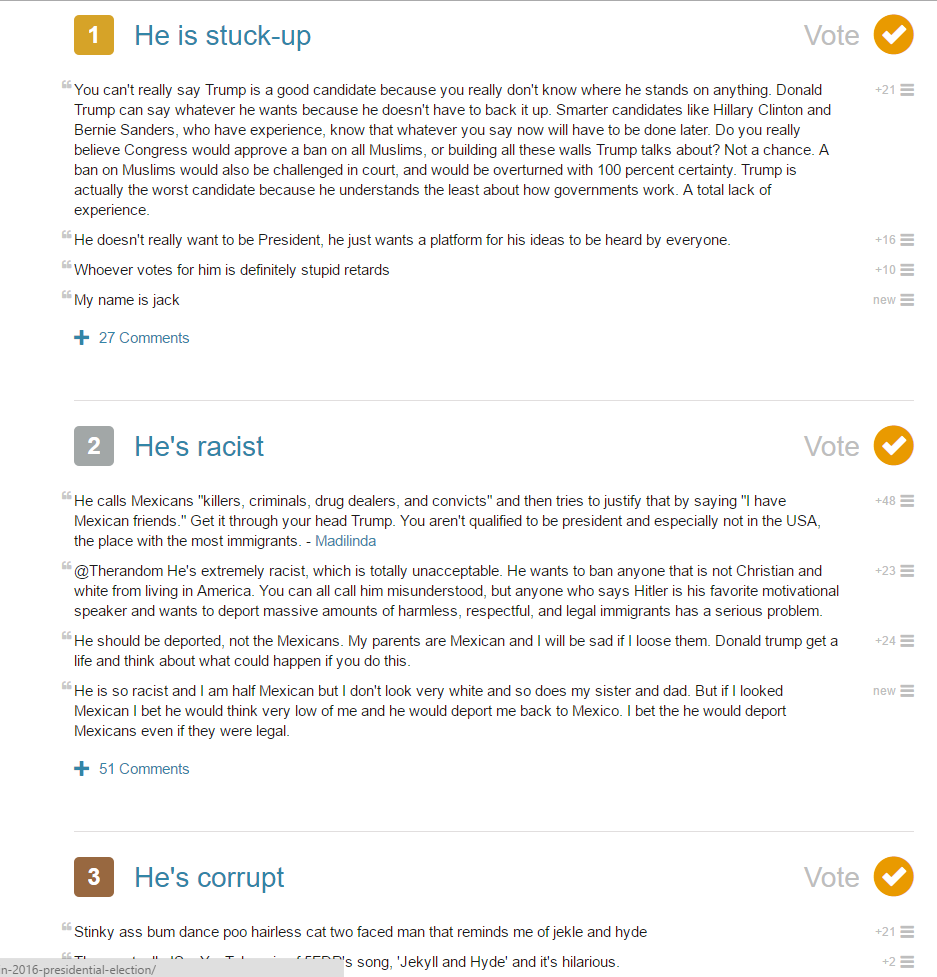
Another frame of media coverage dominated by Donald Trump and, some may argue, Bernie Sanders. Trump and Sanders' revolutionary approach to U.S. politics has changed the race for good, and a lot of that focuses on their personal attributes. Plenty of stories have focused on Trump's deficiencies, outlining why he couldn't, shouldn't or wouldn't be President of the United States.
From toptens.com
This article even outlines ten reasons why Donald Trump should not be the next president, citing his past words, actions, claims, etc.
I find it interesting that when you step back and analyze an article rather than just read it, you find that many articles are biased and have a strong elements of framing and agenda setting.
The Washington
Post has written several articles focused on the negative attributes of Trumps
personalities.They have headlines like
“To defend our Democracy against Trump….” Early in the article, they point out
that the Republican Party should do everything they can to stop Trump.This is an example of candidate attributes. They point out the flaws in the candidate’s
character in this article.In this same
article they show how Trump is completely at odds with the Republican Party,
which is a conflict frame.
The Washington
Post also published an article that is clearly a horse race frame about Cruz and Trump in a race against each other.The even say in the article that race has
entered a “combative phase” between Ted Cruz and Donald Trump.
The article “The
Plausibility of Ted Cruz” by New York Times, Ross Douthat talks
through Cruz’s policy issues on foreign affairs and economic stance.This is a clear issues frame.This article
also focuses on comparing Cruz to Rubio, using words like “attacking” when
discussing how Cruz and Rubio face each other.So we see some horse race framing
as well as conflict frames.Many of the national news, especially New
York Times and Washington Post, they will focus on one type of frame while at
the same time including some if not all four frames in their articles.
As we get closer to the conventions for each respective political party, horse race journalism increases. Frames and narratives begin to look more nuanced and pronounced. On the Democratic side, the focus on delegates and Hillary Clinton's lead in super delegates seems to be a main concern for Bernie Sanders. Clinton continues to lead in pledged delegates, but the Democratic party elites who back her put her even more over the edge. According to polls, Sanders defeats Trump in most states in wider margins than Clinton, meaning he receives more support from Independent voters.
According to a Politico article, Democratic senators are urging Sen. Sanders to stop attacking Clinton because it hurts her in the general election against Trump. Sanders does not seem to be letting up. In an email to supporters, he states that Clinton is fundraising from wealthy campaign donors while he receives money from average Americans. Sanders has out-raised Clinton in multiple months by a wide margin. He gets the most individual donations out of most presidential candidates. Clinton just recently reached her one millionth individual donation when Sanders has had 5 million in the last month and 2 million individual contributions this month. Sanders won Utah, Idaho, and the Democrats Abroad primary by large margins and received more pledged delegates than Clinton even though she won the Arizona Primary.
Democratic elites seem to agree that Clinton is flawed, but she is going to be the nominee. They want Sanders to drop out and unite behind her. Sanders at this point does not seem inclined to do that. The spin on this article is that Sanders has no chance and the only way to stop Trump is to unite behind Clinton. Sen. Claire McCaskill called Trump a "baffoon" and believed that the Sanders/Clinton fight was nothing compared to Trump. There seems to be some conflict between Democratic elites and the Sanders' campaign, but overall they believe Sanders "will do the right thing" and campaign for Clinton. There are about 24 states that haven't voted yet including delegate rich states like California, New York, and Wyoming. The Sanders campaign insists that Sen. Sanders is a better general election candidate than Clinton and they encourage super delegates to switch to their side.
On the GOP side, Republicans are worried that Donald Trump could lose them the House and possibly the Senate. Trump's divisive rhetoric is alienating a number of Americans and this may hurt Republicans chances at securing seats in Congress. Some GOP members believe Trump could get Democrats to vote for him in the Fall. The House Republicans have mostly remained silent on the rise of Trump, Politico reports. As of right now, it's clear the the Republican Party is in disarray and there is no unity among them. Similarly, the Democratic establishment and the DNC chairwoman Debbie Wasserman-Schultz is getting a lot of backlash from Democrats and even a primary opponent has emerged to go against her. Many agree though that the Republican establishment has lost control of their grassroots movement which includes Donald Trump and the Tea Party. The conflict between the GOP elites and their constituents who are going for Trump is much more devastating than what's going on with the Democratic Party. Trump has a broad coalition of support from new voters, Republicans, and even Democrats. The GOP have aided in the rise of Trump over the many years and this could impact the party in a significant way for future elections to come.
Meanwhile, Hillary Clinton has completed switched her attention to the general election. Her campaign believes they have won the nomination and she is attacking Trump more often now and ignoring Sanders. At a speech to a pro-Israel lobby group, she said Trump's neutral stance on the Israel and Palestine conflict shows he does not understand foreign policy. Many Jewish groups also are not fond of Trump. The New York Times article shows the conflict between Republicans, Trump, and Clinton. It also highlights Clinton's policy towards Israel. Clinton also said she would use military force against Iran if they violated the agreement in the Iran deal. She spoke extremely aggressively on making sure Israel remains an ally of the United States and how she would increase relations with the region. Sanders being the only Jewish candidate to not attend the pro-Israel speech caused a stir among pro-Israel groups. However, Sanders requested to speak to AIPAC via satellite, but they changed their policy and did not allow that this year at the conference. Instead Sanders outlined his Middle East foreign policy plan to a crowd in Utah.
This first clip certainly frames itself in discussion
of the horse race. It points out that Sen. Sanders needs 65% of the remaining
delegates in order to win the nomination. The clip shows his polling and the
anchor is quoted saying, “No poll in the upcoming states shows Sanders winning
by enough of a margin.”
While the clip also talks about Sen. Sanders policies on
immigration, that policy talk is framed around whether or not the guest, Rep.
Raul Grijalva, believes that Sanders’ policies and campaign events in recent
days can help him win on ‘Western Tuesday’ in the states of Arizona, Utah and Idaho (Dem).
This clip focuses on conflict between Sanders and
Secy. Clinton ahead of ‘Western Tuesday’. This clip features a Clinton
supporter/delegate, Arizona Vice Mayor Karin Uhlich. The crux of the Clinton
campaigns criticism comes from a vote Sanders cast in 2007 for an immigration
bill drafted by the late Ted Kennedy.
This article discusses Trump’s ‘complex relationship
with Israel’.
In the article it is said that Trump’s rhetoric
concerning Muslims has been a point of criticism among Israeli’s political
class. The Likud party (which Prime Minister Netanyahu belongs to) “… condemned
Trump for denigrating the country’s large minority of Muslim citizens after he
called for an indefinite ban on Muslims entering the United States.”
The article also recounts when Trump was booed at a
Republican Jewish Coalition forum for refusing to, “… say whether he considered
Jerusalem to be the capital of Israel.”
This last clip asks, “Who Is John Kasich”. In the clip
it is said that Kasich is not a, “… run-of-the-mill Republican.” The video
notes that he is a fan of The Grateful Dead and that he was the youngest person
ever elected to the Ohio senate (at the age of 26).
Prior to the year 2016, we would have predicted a presidential race around this time to be uninteresting and not a lot of changes from the politicians we have seen in the past. What voters now call establishment politicians or politicians who are beholden to big money special interests, voters in the past would have just called them normal politicians. They would have normally embraced these politicians who pandered to their concerns most adequately. This political technique does not work in modern day politics. This is partly due to the fact of increasing technology, globalization, and social media. People just do not buy into political speak the way they used to. The Internet has provided a way to immediately expose politicians who lie. The mainstream media has provided narratives and horse race journalism, which still exists today, but as we have seen with the rise of Donald Trump, the media may not be relevant in certain regards. The media's attention and scrutiny of Trump's false statements and outrageous behavior may just be helping Trump. People don't trust the media as much as they used to.
Many blame the media for perpetuating the rise of Republican front runner Donald Trump, but they ignore the fact that the Republican establishment created Trump. Right wing media like Fox News and prominent conservative figures like Glenn Beck, Sarah Palin, and Sean Hannity have all played a role in assisting Trump. The birther movement, which started with Trump and the rise of the Tea Party in Congress all lead up to this moment in American politics. These figures may have done this inadvertently or on purpose. At this point, it's the unpredictability of Trump and the lack of historical examples that makes Trump's rise to power particularly worrisome.
On the Democratic side, we notice another divide between, once again establishment politicians and grassroots activists. Hillary Clinton and Bernie Sanders do have profound differences. Sanders upset win in Michigan may prove a tide turning against Clinton. Sanders even received a larger share of African American support than he had in the past. Five Thirty Eight called Sanders' win: "Sanders's win in Michigan was one of the greatest upsets in modern political history."There are certain profound and amazing things happening in both political parties and I believe history will decide if these instances will have a profound affect on presidential politics and political parties in the future.
Clinton has the backing of the entire Democratic establishment and even some neocon Republicans may consider her for the general election if she were to go against Trump. Bernie Sanders has received the endorsement of former Bill Clinton Secretary of Labor, Robert Reich and former DNC vice chair Congressman Tulsi Gabbard. These endorsement may represent a particular divide among Democrats, who view Clinton as to tied into Wall Street or big money interests. Americans who see powerful lobbyists and wealthy campaign contributors as a problem in an American democratic society. Gabbard believes Clinton is too hawkish in her foreign policy and said Clinton has supported wars of interventionist regime change in Iraq, Libya, and Syria. Reich has stated that Clinton is the best president for the political system we have now and Sanders is the best president to change the system for the betterment of getting money out of politics. It's understood that Barack Obama had a super PAC and raised money from Wall Street, but he was never criticized for that because he was working within the system. There was not an alternative politician who did not accept money from Wall Street until a democratic socialist Senator from Vermont came into the race.
The concept of citizen media has been prominent since the 2008 election. The news agency Motherjones received footage of Romney saying 47% of the country will not vote for him, which was seen as dismissive. It was attributed to him losing to Obama. In 2016, citizen journalism is even more prominent. A reporter from the news organization called the Intercept once approached Hillary Clinton on film and asked her why she won't release her Goldman Sachs transcripts. Clinton at first dismissed the question and that goes viral. At a Democratic debate, moderator Chuck Todd asks Clinton if she would release the transcripts and she says she will if everyone will release their transcripts as well. This incident does not look good for Clinton and it immediately backfires. At Democratic debates and town halls, Clinton is repeatedly asked about the transcripts and she gives the same non-answer. It adds to her high dishonesty and low trustworthiness ratings in regards to her FBI investigation and other issues. The issue was finally raised by Bernie Sanders himself, who now calls for Clinton to release her speeches as part of his stump speech.
Sanders rise is attributed to another populist Senator from Massachusetts, Elizabeth Warren who criticizes the power that Wall Street has over Congress. She has also scrutinized Hillary Clinton by proclaiming she views powerful interest groups as her constituency. The current Democratic National Committee Chairwoman, Congresswoman Debbie Wassermann Schultz, has been criticized by other members of the Democratic Party for overturning the ban on lobbyists that Obama implemented in 2008 and also for her support of loan sharks.
But in the grand scheme of things, Trump and Sanders resonate with voters who want someone in the White House that is an outsider and do not represent corporate donors. However, they are opposite in terms of how they want to accomplish their goals. Sanders was a congressman, mayor and now a senator. Trump was a reality television star and businessman and has no political experience. However, as we have seen with these two candidates both Sanders and Trump set the agenda for what the discussion is going to be at debates. They have both impacted the presidential race in different ways. If the general election were to be Trump versus Sanders then that would be something we have never seen in the history of American presidential elections.
The two narratives
that I would like to discuss are 1.) Donald Trump as a winner and 2.) Marco Rubio
as the ‘Republican Obama’.
Donald
Trump has said since he has gotten into the race (that is, up until Monday
night) that he is a winner; that he loves to win, that he always wins and that
he will win. He said he would win in Iowa. He said that Iowans loved him and
that he was going to win. Ultimately he came in second. The media has picked up
on this narrative and has clung to it. CNN often goes live to Donald Trump’s
rallies to listen to him say what he has to say. The polls have often shown him
in front and the media has followed that trend. As recently as October or
November pundits were talking about the staying power of the ‘Summer of Trump’.
Trump is currently 30% up in New Hampshire, so it will be important to see how
that narrative plays out, and if he can win New Hampshire, South Carolina, or
other primary states.
Of course
Marco Rubio has his 3-2-1 plan. Third in Iowa, second in New Hampshire, first
in South Carolina. Under this narrative, Donald Trump, if ever a winner, might
not be a winner for very long, with respect to presidential primary politics.
Marco Rubio is called the ‘Republican Obama’ (mostly by the media) due to the
fact that he is a young (44) first term senator (and he’s a racial minority).
Rubio’s third place finish in Iowa is said to have been a beating of
expectations. It has been celebrated in the days since as an unmitigated
victory for the senator. If Rubio can follow through with his 3-2-1 plan, if he
can win South Carolina going into the SEC Primary (traditionally called Super
Tuesday) and carry momentum, he could create a situation in the Republican Party
where two candidates duke it out.
Unlike President Obama, however, Rubio is
considered an establishment candidate and would not have a Hillary Clinton (an ‘inevitable
candidate’) to run against.