Showing posts with label 2016 presidential campaign. Show all posts

Wednesday, April 13, 2016

Confirmation bias in the media: Show me, tell me

By THOMAS HARTWELL

We, as humans, believe that we are inherently correct and seek out information that agrees with our thinking. How does this apply to our daily thinking or our consumption of products, services, and news?


Confirmation bias, or the interpreting of evidence or information in regards to existing beliefs, has been addressed often in the discussion of the presentation of news. Most believe that there should be no biases in news reporting, and journalists are taught to stay completely objective in the presentation of hard news. While, in a perfect world, consumers of news could watch/read news presented completely objectively and make educated decisions based on what they read, we do not live in a perfect world. News organizations have to incorporate what sells into the presentation of their stories. There is also a consideration of gatekeepers who run the media organizations. While the goal should always be objective reporting, people have a tendency to have strong opinions on political issues, which many times manifest themselves in subtle biases in reporting.

When we explore confirmation bias in the larger media outlets, we often encounter a widely-accepted thought pattern: "CNN and MSNBC are liberal, Fox is conservative." While this is now considered the norm, the media outlets themselves would never come out and admit to it. The media outlets, therefore, must disguise their biases as "just another way of reporting."

Let's look at Fox and MSNBC's reporting of the same story. A racially insensitive joke was told at a charity dinner recently, and both outlets wrote a story on it. Keeping in mind that Fox is considered conservative and MSNBC liberal, there is a subtle difference in the reporting in a couple ways:

Image and story from foxnews.com
Image and story from msnbc.com
1. The headlines: In Fox's case, the headline reads that both Mayor De Blasio and Hillary Clinton take part in the joke and draw criticism. If we consider Fox's possible confirmation bias, it would make sense that they would want to frame Hillary in this way. Whereas, in MSNBC's case, only De Blasio takes part in the joke, and even then it's presented as "coming at a bad time" rather than being "racially-tinged."

2. The visuals: Fox shows Clinton and De Blasio laughing and seemingly celebrating with the headline "racially-tinged joke" hovering above. It seems to be framed as the two enjoying the insensitive comment. MSNBC instead shows Clinton off to the side looking on as the joke is made. This way, she seems to not take part in the joke making. Clinton also is even standing next to the African-American gentleman, further separating herself from the insensitivity.

Images, as we've already seen, can speak a thousand words in reporting, and often do. The images we see can impact our impression of the candidate depicted. For these examples, I'll choose a picture of Ted Cruz from CNN and one from Fox.

Image result for cnn presidential race cruz
Image from cnn.com
Image result for cnn presidential race
Image from foxnews.com
In these cases, the presentation of Ted Cruz is considered in the photos chosen to be published on the sites. CNN's picture choice is less than flattering, while Fox's looks like a campaign flier.

While minds won't necessarily be changed by only images or word choice, the presentation of information or images can alter the way that people think about a subject. Objective news reporting and an educated public would be preferable to what is widely accepted as a biased news environment, but in order to inform the public, the public must want to be informed. If it takes subtle biases (even no-so-subtle ones) to inform them, then so be it -- I'll take the news with a grain of salt.


Wednesday, March 23, 2016

Framing the presidential race

By THOMAS HARTWELL

The presidential race in any context is a media frenzy, but this race has been unlike any before it in many ways. As with any story, the media make choices as to how to approach the stories surrounding the presidential race, and there are four commonly used "frames" of presentation, all of which have been used to cover the year's campaigns.

Horse Race:


Horse race journalism in the political spectrum is the presentation of information as a contest or comparison of, in this case, presidential candidates. There's been a lot of talk about a possible convention contest for the Republican nomination this campaign season, and that has opened the door for A LOT of horse race journalism. With a race this close between Trump and Cruz and a candidate pulling delegates away from the two front-runners, many outlets are taking the opportunity to present some "who will win the sprint to 1,237?" stories. There has been some in regard to the Democrats' race as well, but with a race on the left seemingly more and more decidedly won by Hillary, there have been more stories about the change that Sanders' campaign has brought to politics than "who will win?"
From the Associated Press
Conflict:

Horse race and conflict presentation of the Republican race have gone hand-in-hand this campaign season. As the race has continued and candidates have dropped out, there has been more opportunity for conflict-frame journalism. For instance, this CNN article incorporates elements of the delegate race, but describes the race for the nomination between Trump and Cruz as a "duel." A search for stories about Trump on CNN and other news outlets provides a look at the presentation of Trump's campaign strategy: conflict frame and a "Trump vs..." mentality. 

From cnn.com search

Issues:

Candidates of the same party and especially opposite parties LOVE to slam each other on policy issues -- the presidential race produces plenty of these opportunities. While most attacks come on an opponent's stance on ongoing issues, current events also play a part. For example, Trump and Cruz chose to slam President Obama on immigration regulations and international terrorism in response to terrorist attacks in Brussels, Tuesday. Stories written on the issues provide voters and onlookers with the ability -- hopefully objectively, but we all know, not so much -- to make decisions based on those issues. Trump has also generated lots of attention and media spotlight for himself by making large and outrageous issue claims. He's actually winning in the presidential race on lots of the "important issues," because he has so much coverage out there on his policy on those issues.

From msnbc.com
Candidate Attributes:

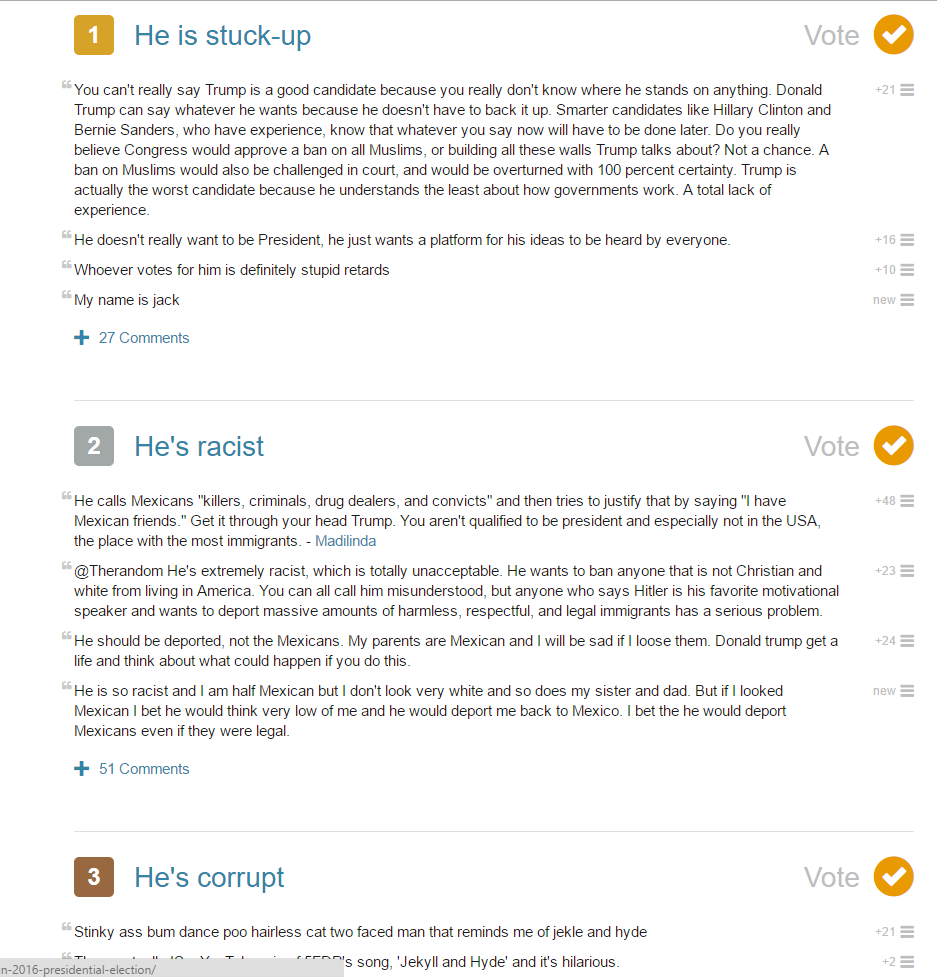
Another frame of media coverage dominated by Donald Trump and, some may argue, Bernie Sanders. Trump and Sanders' revolutionary approach to U.S. politics has changed the race for good, and a lot of that focuses on their personal attributes. Plenty of stories have focused on Trump's deficiencies, outlining why he couldn't, shouldn't or wouldn't be President of the United States.

From toptens.com
This article even outlines ten reasons why Donald Trump should not be the next president, citing his past words, actions, claims, etc. 

National News and Framing

By Branden Camp

I find it interesting that when you step back and analyze an article rather than just read it, you find that many articles are biased and have a strong elements of framing and agenda setting.

The Washington Post has written several articles focused on the negative attributes of Trumps personalities.  They have headlines like “To defend our Democracy against Trump….” Early in the article, they point out that the Republican Party should do everything they can to stop Trump.  This is an example of candidate attributes. They point out the flaws in the candidate’s character in this article.  In this same article they show how Trump is completely at odds with the Republican Party, which is a conflict frame.


The Washington Post also published an article that is clearly a horse race frame about Cruz and Trump in a race against each other.  The even say in the article that race has entered a “combative phase” between Ted Cruz and Donald Trump.


The article “The Plausibility of Ted Cruz” by New York Times, Ross Douthat talks through Cruz’s policy issues on foreign affairs and economic stance.  This is a clear issues frame.  This article also focuses on comparing Cruz to Rubio, using words like “attacking” when discussing how Cruz and Rubio face each other.  So we see some horse race framing as well as conflict frames.  Many of the national news, especially New York Times and Washington Post, they will focus on one type of frame while at the same time including some if not all four frames in their articles.

Monday, March 21, 2016

Media Frames on the 2016 Presidential Race


As we get closer to the conventions for each respective political party, horse race journalism increases. Frames and narratives begin to look more nuanced and pronounced. On the Democratic side, the focus on delegates and Hillary Clinton's lead in super delegates seems to be a main concern for Bernie Sanders. Clinton continues to lead in pledged delegates, but the Democratic party elites who back her put her even more over the edge. According to polls, Sanders defeats Trump in most states in wider margins than Clinton, meaning he receives more support from Independent voters.

According to a Politico article, Democratic senators are urging Sen. Sanders to stop attacking Clinton because it hurts her in the general election against Trump. Sanders does not seem to be letting up. In an email to supporters, he states that Clinton is fundraising from wealthy campaign donors while he receives money from average Americans. Sanders has out-raised Clinton in multiple months by a wide margin. He gets the most individual donations out of most presidential candidates. Clinton just recently reached her one millionth individual donation when Sanders has had 5 million in the last month and 2 million individual contributions this month. Sanders won Utah, Idaho, and the Democrats Abroad primary by large margins and received more pledged delegates than Clinton even though she won the Arizona Primary.

Democratic elites seem to agree that Clinton is flawed, but she is going to be the nominee. They want Sanders to drop out and unite behind her. Sanders at this point does not seem inclined to do that. The spin on this article is that Sanders has no chance and the only way to stop Trump is to unite behind Clinton. Sen. Claire McCaskill called Trump a "baffoon" and believed that the Sanders/Clinton fight was nothing compared to Trump. There seems to be some conflict between Democratic elites and the Sanders' campaign, but overall they believe Sanders "will do the right thing" and campaign for Clinton. There are about 24 states that haven't voted yet including delegate rich states like California, New York, and Wyoming. The Sanders campaign insists that Sen. Sanders is a better general election candidate than Clinton and they encourage super delegates to switch to their side.

On the GOP side, Republicans are worried that Donald Trump could lose them the House and possibly the Senate. Trump's divisive rhetoric is alienating a number of Americans and this may hurt Republicans chances at securing seats in Congress. Some GOP members believe Trump could get Democrats to vote for him in the Fall. The House Republicans have mostly remained silent on the rise of Trump, Politico reports. As of right now, it's clear the the Republican Party is in disarray and there is no unity among them. Similarly, the Democratic establishment and the DNC chairwoman Debbie Wasserman-Schultz is getting a lot of backlash from Democrats and even a primary opponent has emerged to go against her. Many agree though that the Republican establishment has lost control of their grassroots movement which includes Donald Trump and the Tea Party. The conflict between the GOP elites and their constituents who are going for Trump is much more devastating than what's going on with the Democratic Party. Trump has a broad coalition of support from new voters, Republicans, and even Democrats. The GOP have aided in the rise of Trump over the many years and this could impact the party in a significant way for future elections to come.

Meanwhile, Hillary Clinton has completed switched her attention to the general election. Her campaign believes they have won the nomination and she is attacking Trump more often now and ignoring Sanders. At a speech to a pro-Israel lobby group, she said Trump's neutral stance on the Israel and Palestine conflict shows he does not understand foreign policy. Many Jewish groups also are not fond of Trump. The New York Times article shows the conflict between Republicans, Trump, and Clinton. It also highlights Clinton's policy towards Israel.  Clinton also said she would use military force against Iran if they violated the agreement in the Iran deal. She spoke extremely aggressively on making sure Israel remains an ally of the United States and how she would increase relations with the region. Sanders being the only Jewish candidate to not attend the pro-Israel speech caused a stir among pro-Israel groups. However, Sanders requested to speak to AIPAC via satellite, but they changed their policy and did not allow that this year at the conference. Instead Sanders outlined his Middle East foreign policy plan to a crowd in Utah.


Friday, March 11, 2016

Republican party aims to trump Trump as candidate furthers his delegate lead


By THOMAS HARTWELL, ESTI AFANADOR AND CHRISTIANI FERNANDEZ

The 2016 presidential campaign has been one that has, in many ways, strayed from the normal workings of U.S. elections, with the season’s rhetoric centered around the anger and distrust of a “corrupt Washington.” While both sides have seen revolutionary political strategies and several broken ballot records, the Republican party’s election has undeniably been the more colorful of the two, and Donald Trump has captured voters’ attention. The Republican race to the general election is narrowing, and the Trump campaign seems to be rallying the needed public support to face the Democrats in November.

“The Trump phenomenon – no one saw this coming. No one really understands why it’s happening – what’s going on – but I’ve got some ideas,” said political expert Kerwin Swint.

Swint is an author, speaker and professor of political science at Kennesaw State University. He has run campaigns, written books and his work has appeared in several national and international media outlets. Swint said that the “Trump phenomenon” as well as this campaign season’s obviously splintered GOP is something that has been in the cards for a while and has the potential to have lasting effects.

“What’s going on in the Republican party is a real revolution,” said Swint. “It is serious, it is dramatic, it is significant and it’s going to have long-term consequences.”
While there are plenty of voters out there who have voiced their discontent with Trump, more surprisingly, said Swint, is the amount of resistance Trump is receiving from the, so-called, establishment Republicans. The establishment fears that a Trump nomination means a Clinton victory, but it goes beyond that.
“The other part of their thinking … is, ‘Good Lord, he might win,’ which might be worse,” said Swint. “President Trump would pay no attention or very little attention to the establishment.”
Swint also said that a number of Republicans would rather see Clinton win the general election than Trump – a party line-crossing that has not been seen in decades.
Trump has appealed, most abundantly, to white, blue-collar workers who are tired of Washington and who are willing to cross party lines to vote an “outsider” into the Oval Office. His ability to pick up Independent votes has given him an edge in the delegate count, said Swint, but the damage that he and others have been doing to the GOP this season has forced some voters to display their unhappiness in other ways.

  
Delegate count in the 2016 presidential race so far, according to CNN.
If a candidate does not receive the shown majority of delegates (1,237),
the party goes to a convention, which nominates a candidate for the general
election. Source: http://www.cnn.com/election/ 
Zac Carr, a 25-year-old Cobb County voter said his primary vote was cast as a symbol of his own unhappiness with the candidates this campaign season.
“I voted for Rand Paul despite the fact that he is no longer running,” said Carr. “I asked for a non-partisan ballet because I, like George Washington, believe that the two-party system only polarizes our country. I wanted to do my part by showing that I believe non-partisan is preferred over Republican or Democrat.”

Carr said that the “nastiness” in the Republican race forced his hand and initiated his Independent vote.

Lott Middlemas, a Florida voter and international relations and Chinese double major at the University of South Carolina, agreed that the GOP race has been ugly, but said that its dirty tactics might be good for the number of voters in a general election.

“I think that voter turnout on both sides will increase noticeably for both parties as a result of the inflammatory politics of the Republican party during this election cycle,” said Middlemas. “The Republicans have been talking for years about expanding their base of support by appealing to minorities, but I don't think they'll see that as being necessary anymore since they've managed to draw out many more white voters than usual without having to soften their stances on economic and social issues that are often important to minority voters.”

The Democrats, said Middlemas, will turnout in larger numbers simply because of their fear of a Trump presidency and Clinton, he said, will beat Trump handily.

Not so fast, says Swint. A Clinton win isn’t such a sure-fire thing in a head-to-head.

“There are people assuming that Trump wouldn’t have a chance in a general election against Hillary Clinton. I’m not necessarily in agreement with that,” he said. “One of the strengths of Trump is that he’s put together a pretty broad coalition … It’s certainly not a slam dunk [for Clinton].”
It is his ability to appeal to groups of varying demographics and political opinion that potentially makes Trump dangerous, said Swint.
Yet another scenario in the Republican race is a nomination by a convention. Trump leads by about 100 delegates with 460, but he does have to get through a still very present Ted Cruz, and some wonder if the other Republican candidates may be able to pull enough delegates away from Trump to prevent his receiving a majority (1,237 delegates) and force the party to the convention. In this scenario, said Swint, the Republican leadership runs the risk, should they nominate someone other than Trump, of losing grip on their party.

“I think if they do take it away from [Trump] at the convention, I think he absolutely will run independent,” said Swint. “And I think at that point, he would be real interested in just wrecking the party for the Republicans.”
A non-Trump convention nominee would not only anger Republican voters, said Swint, but it would also cause “wheeling and dealing” between presidential candidates, state governments and others – precisely the kind of Washington antics voters are tired of.

According to Middlemas, though, Republican voters don’t need to worry about a convention.

“Super Tuesday cemented Donald Trump's supremacy in this race,” he said. “Sen. Cruz might be able to win a few more states, but Trump will certainly have a majority of delegates by the time the Republican national convention rolls around.”

Whether or not Trump has solidified his nomination remains to be seen, but polls with only Trump and Clinton’s name on them have begun to show up. Current CNN polls show either Democrat defeating Trump in November, but November is still miles down the road, said Swint.

“The general election [polls] right now are meaningless,” said Swint. “The election’s months and months away. We’re going to have coalitions, we’re going to have world events, we’re going to have economic developments that are going to affect that.”


All we can do now, said Swint, is wait and watch.

Wednesday, March 9, 2016

Analysis of the Presidential Election: Sanders, Trump and Clinton

Prior to the year 2016, we would have predicted a presidential race around this time to be uninteresting and not a lot of changes from the politicians we have seen in the past. What voters now call establishment politicians or politicians who are beholden to big money special interests, voters in the past would have just called them normal politicians. They would have normally embraced these politicians who pandered to their concerns most adequately. This political technique does not work in modern day politics. This is partly due to the fact of increasing technology, globalization, and social media. People just do not buy into political speak the way they used to. The Internet has provided a way to immediately expose politicians who lie. The mainstream media has provided narratives and horse race journalism, which still exists today, but as we have seen with the rise of Donald Trump, the media may not be relevant in certain regards. The media's attention and scrutiny of Trump's false statements and outrageous behavior may just be helping Trump. People don't trust the media as much as they used to.

Many blame the media for perpetuating the rise of Republican front runner Donald Trump, but they ignore the fact that the Republican establishment created Trump. Right wing media like Fox News and prominent conservative figures like Glenn Beck, Sarah Palin, and Sean Hannity have all played a role in assisting Trump. The birther movement, which started with Trump and the rise of the Tea Party in Congress all lead up to this moment in American politics. These figures may have done this inadvertently or on purpose. At this point, it's the unpredictability of Trump and the lack of historical examples that makes Trump's rise to power particularly worrisome.

On the Democratic side, we notice another divide between, once again establishment politicians and grassroots activists. Hillary Clinton and Bernie Sanders do have profound differences. Sanders upset win in Michigan may prove a tide turning against Clinton. Sanders even received a larger share of African American support than he had in the past. Five Thirty Eight called Sanders' win: "Sanders's win in Michigan was one of the greatest upsets in modern political history." There are certain profound and amazing things happening in both political parties and I believe history will decide if these instances will have a profound affect on presidential politics and political parties in the future.

Clinton has the backing of the entire Democratic establishment and even some neocon Republicans may consider her for the general election if she were to go against Trump. Bernie Sanders has received the endorsement of former Bill Clinton Secretary of Labor, Robert Reich and former DNC vice chair Congressman Tulsi Gabbard. These endorsement may represent a particular divide among Democrats, who view Clinton as to tied into Wall Street or big money interests. Americans who see powerful lobbyists and wealthy campaign contributors as a problem in an American democratic society. Gabbard believes Clinton is too hawkish in her foreign policy and said Clinton has supported wars of interventionist regime change in Iraq, Libya, and Syria. Reich has stated that Clinton is the best president for the political system we have now and Sanders is the best president to change the system for the betterment of getting money out of politics. It's understood that Barack Obama had a super PAC and raised money from Wall Street, but he was never criticized for that because he was working within the system. There was not an alternative politician who did not accept money from Wall Street until a democratic socialist Senator from Vermont came into the race.

The concept of citizen media has been prominent since the 2008 election. The news agency Motherjones received footage of Romney saying 47% of the country will not vote for him, which was seen as dismissive. It was attributed to him losing to Obama. In 2016, citizen journalism is even more prominent. A reporter from the news organization called the Intercept once approached Hillary Clinton on film and asked her why she won't release her Goldman Sachs transcripts. Clinton at first dismissed the question and that goes viral. At a Democratic debate, moderator Chuck Todd asks Clinton if she would release the transcripts and she says she will if everyone will release their transcripts as well. This incident does not look good for Clinton and it immediately backfires. At Democratic debates and town halls, Clinton is repeatedly asked about the transcripts and she gives the same non-answer. It adds to her high dishonesty and low trustworthiness ratings in regards to her FBI investigation and other issues. The issue was finally raised by Bernie Sanders himself, who now calls for Clinton to release her speeches as part of his stump speech.

Sanders rise is attributed to another populist Senator from Massachusetts, Elizabeth Warren who criticizes the power that Wall Street has over Congress. She has also scrutinized Hillary Clinton by proclaiming she views powerful interest groups as her constituency. The current Democratic National Committee Chairwoman, Congresswoman Debbie Wassermann Schultz, has been criticized by other members of the Democratic Party for overturning the ban on lobbyists that Obama implemented in 2008 and also for her support of loan sharks. 

But in the grand scheme of things, Trump and Sanders resonate with voters who want someone in the White House that is an outsider and do not represent corporate donors. However, they are opposite in terms of how they want to accomplish their goals. Sanders was a congressman, mayor and now a senator. Trump was a reality television star and businessman and has no political experience. However, as we have seen with these two candidates both Sanders and Trump set the agenda for what the discussion is going to be at debates. They have both impacted the presidential race in different ways. If the general election were to be Trump versus Sanders then that would be something we have never seen in the history of American presidential elections.


Tuesday, March 8, 2016

Twitter Tirades, Kasich Kindness and Revolution Rhetoric: The State of the Race 2016

By THOMAS HARTWELL

The 2016 presidential campaign has been underway for months, and various candidates have utilized various communication outlets and tactics to ensure voters that they are the best candidate for office. There are three themes that, over the entirety of the 2016 campaign season, have stuck out to me. These three themes and the candidates behind them have impressed me (whether or not I care to endorse them).

#1 Trump Twitter Tirades


From Donald Trump Twitter
Donald Trump has always made "good" use of his twitter, promoting his "enthralling" personal thoughts and spotlighting his "razor-sharp insight" into politics, but this campaign season, he has outdone himself. There is something to be said for the impact of "Twitter storms." Consumers go on them constantly and are immediately contacted by the organizations they drag through the mud, offering steals and deals to try to make amends and stifle public, negative publicity. Trump has used his Twitter storms and account as both an entertainment outlet and a tool for his campaign. His attacks on other candidates, the media and his bolstering of his own accomplishments have drawn attention and even headlines. As we have discussed in a course which revolves around political communication, a candidate must be able to attract attention and spark discussion on social media, as well as in traditional media. Trump has done just that both with his "shocker statements" in person, recapturing some of that spotlight, but also with Twitter storms taking the wind out of less entertaining candidates' sails.

From Donald Trump Twitter


Potential downfall: In a general election against Hillary, how will Trump's Twitter foot stamping and name calling fair against Hillary's ability to get into the nitty-gritty on the issues?

#2 The Revolution Rhetoric: Bernie Sanders


How many time have we heard Bernie Sanders say the words "political revolution" and "top one percent" in his speeches, at debates, in interviews, and at rallies? While some see Sanders' focus on the issue he is most passionate about -- corporate greed, fixing income inequality, changing a corrupt campaign finance system, etc. -- as a weakness, calling him a one-issue candidate, his supporters see it as more of a brand. Sanders' brand through his rhetoric, whether critics will admit it or not, have propelled him to where he is now. Sanders, a self-proclaimed Democratic Socialist was expected to be laughed out of this primary election (much like another presidential candidate this season). Through a radical, revolutionary brand in his rhetoric, and the help of many, many Millennials in voting and spreading the word, Sanders has rocketed to several neck-and-neck state primaries with Hillary Clinton. His rhetorical brand of a government "truly for the people" has connected with many voters' anger with Washington and corporate America's greed (again, does this remind you of another candidate?). It cannot be denied that Bernie's brand is catching wind either -- even Hillary Clinton began borrowing some of his lines recently. Might Hillary be considering Bernie's brand, and might she be considering a Bernie VP to better her own stance in the eyes of Democratic Independents? We'll have to see.

Potential downfall: While his rhetoric is exciting, many see him as a one-issue candidate and his young voter following, while excited about him, doesn't turn out to polls in quite the number his campaign might hope.

#3 Kasich's Kindness

John Kasich has time and time again refused to "go negative" against other presidential candidates. Many feel that it is this choice that has doomed Kasich's campaign to fail from the beginning, but I'm not so sure. Kasich has taken the opposite approach of a Trump or, most recently, a Rubio this campaign season, attempting to show through his actions, not fighting words, that he is the candidate that can "get stuff done." As the race progressed, it became more and more obvious that Kasich wasn't a frontrunner, and, while he survived into the top four, he wasn't destined to be the next president, so why remain gentle, kind, patient Kasich? Kasich, too, is promoting a brand, but not with rhetoric; his is with non-verbal cues, actions, and choices. Kasich maintains a brand, still, of selling his product instead of commenting on why the others' are inferior. There have been inklings, however, that Kasich's brand is strategic. If Kasich does not take opportunities to attack candidates, even if the opportunity is handed to him, he remains a friend and is has been suggested that this may be his ploy for VP. The Ohio governor may be using his political communication skills as a sort of Jedi mind trick on voters, and instead, he may be focusing his energy on the frontrunners' right-hand seat.

Potential downfalls: Kasich continues to pull delegates away from the frontrunners and runs the risk of contributing to a Republican convention in which his VP dreams are slightly more cloudy.


Monday, March 7, 2016

Kasich hosts Kennesaw State University town hall

By JONATHAN ORRILLO, THOMAS HARTWELL, JUSTIN NADYBAL, ADAM MAELAND

KENNESAW, Ga. – Republican presidential candidate John Kasich visited Kennesaw State, Tuesday, drawing more than 400 onlookers.

Kasich gave a short speech on his campaign platform before opening the floor to questions from the audience. Comments ranged from policy issues to questions of Kasich’s lack of aggression on the campaign trail.

Ohio Gov. John Kasich answers an audience member's question at Tuesday's KSU town hall meeting.
Photo by Thomas Hartwell

“I want to know how you’re going to stick it to Trump [and the others],” said one audience member.

Since stepping on KSU’s campus, Kasich made his message to audience members clear: Everyone has a purpose in life, and it is their job to find and fulfill it. When Kasich entered the Carmichael Student Center, he began by telling students that change starts with them.

Presidential hopeful John Kasich speaks to audience members of all ages at Tuesday's KSU town hall. Photo by Thomas Hartwell

“You are unique, and you are special and you have a purpose,” he said.

Kasich also spoke bluntly about issues like the economy, workforce and student debt, tailoring issues to the millennial-dominated crowd.

“We made a promise to these millennials that, if you go to college, you’ll get a good job, and somehow that promise has been broken,” he said.

While it might be expected that students would be upset by this and statements like it, many responded positively.

“He gave us a dose of reality rather than you know trying to build or hope up,” said University of Georgia student Brett Smith. “It is easy to offer free college, but I think he realizes that’s not feasible.”

The town hall left some students at KSU feeling that the presidential candidate was approachable and willing to talk with them one-on-one, taking questions and pictures with them after the meeting.

 “[It’s great] seeing someone in person and exactly hearing what they have to say, not just seeing them on TV,” said KSU student Alyx Fotiades. “I am a stronger supporter.”

Kasich has been gaining momentum in the republican race because of his experience and demeanor. Supporters view Kasich as a man that is an honest candidate and not an entertainer.

“He sees the glass as half full,” said Kasich supporter Tom Prior. “Almost all the other candidates see the glass as half empty.”

Kasich continued his campaign trail legacy, telling audience members he would continue to run a “friendly” campaign for votes, not entertainment.

John Kasich listens to student questions and comments at Tuesday's KSU town hall. Photo by Thomas Hartwell

“I am not going to go out there and do something to just grab attention,” he said. “Either you walk into a room and frighten people and make promises you can’t deliver on, or you walk into a room and say it’s going to be fine, we have path to fix this. Now that might not be as sexy, but that’s life.

Even with his positive demeanor, Kasich has stirred up controversy on the campaign trail. One day prior to the KSU town hall, Kasich stated that in 1978 he won the statehouse because women “left their kitchens to go vote.” Regardless of his statement, a significant amount of women attended and showed their support at the town hall.

“I think it was 75 or 80 percent of the women at that time did not work,” said Kasich supporter Angie Coleman. “The meeting that he was having they were called coffee house meetings. Instead of town halls they were small meetings where they were literally meeting in kitchens. It was not sexist, and anyone who thinks that about Kasich is silly.”

Kasich plans to continue his town hall meeting visits to Tennessee, Vermont, Massachusetts and Michigan in the coming weeks