Showing posts with label Political Communication. Show all posts

Saturday, April 23, 2016

Political Communication's E-Portfolio

1.      Identify and discuss the significance of three key concepts you learned this semester
I think one of the most important concepts I learned about this semester was framing. Framing is something that is done by political campaigns, political parties and the media. I learned that a political campaign can be framed by the media in at least four ways: Conflict, Horserace, Issue and Candidate Attribute.
There is a popular assumption that candidates focus most on being likeable – on their attributes. This assumption held up when I coded the campaign website for Governor Martin O’Malley back in January. O’Malley was very concerned with being seen as the lifelong democrat, having “15 years of executive experience” and being part of an “Irish Rock band”. But when the governor did talk about issues, it was seen that he took more of a negative approach, focusing on what was broken instead of how he would fix it. O’Malley framed his discussion of issues through the use of fear.
In this piece from March 21 I took a brief look into framing and how it practically plays out in the news coverage of a presidential election. In this blog post I quoted a clip that said that, “No poll in the upcoming states [Arizona, Utah and Idaho] shows Sanders winning by enough of a margin.”
Senator Sanders won Idaho by 78%-21% and won Utah by 79%-20.%, losing Arizon 57%-39%.
One of the first things I did as a part of this class was to parse out exactly what political communication is and what it means in a practical and theoretical sense. As a communication major my overall perspective on this is influenced by my background in communication. I wrote for my first blog post this semester:
“Political communication is first and foremost the academic pursuit of an interdisciplinary understanding of the ways in which studies of political science (and the applied ‘politics’) interact with studies of communication (and applied fields including but not limited to ‘journalism’, ‘public relations’ and ‘advertising’).”
One thing I have found fascinating about the 2016 presidential election is the adoption of the use of the social media application Snapchat. Governor Lincoln Chafee was an early adopter of Snapchat, though it did not ultimately help him in his attempts to secure the Democratic nomination. Back in June only seven candidates for president had a Snapchat account, and all of them have since dropped out, with the most recent drop out being Senator Marco Rubio. I am very interested on a retrospective piece on the role of Snapchat (and all social media apps and platforms) in this election, and I wonder if there will be any theorizing that the presence of indomitable candidates such as Secretary Clinton and Donald Trump make it impossible to truly gauge the effectiveness of ever-evolving technology.
Very similar to framing are narratives. Every campaign and each candidate, attempts to weave a specific narrative about themselves, their campaign and the country. Back in February I investigated the narratives of “Donald Trump the Winner and Marco Rubio ‘The Republican Obama’”.
It was kind of pre-mature to observe the first narrative of Donald Trump as a winner back in early February. But two-and-a-half months later and the narrative has not only been continued in the media, but has been proven true by the voters.

Figure 1:  50% of these results show Donald Trump as a winner, even going as far as to say that he will be the nominee.
Trump has won twenty-two contests, twice as many as Senator Ted Cruz his closest contender. Trump has also one 2.3 million more votes than Senator Cruz. Trump and the media have constantly driven home the narrative of Trump as a winner, and so far that narrative has proven actually true.
            The narrative of Senator Rubio as ‘The Republican Obama’ have not held up, however. Arguably it was a weak narrative to begin with, seeing as Marco Rubio was the establishment candidate in comparison to some of his opponents (Donald Trump, Ben Carson, Carly Fiorina and even fellow senator Ted Cruz) and seeing as he never could get the race down to just being between him and one other opponent. Additionally, if the GOP ever had an inevitable candidate in 2016, that candidate was nothing similar to Senator Clinton in 2008. Rubio withdrew from the race for the presidency on March 15 and two days later on March 17 he announced he would not be running for reelection for senate. In fact it is thought now that Rubio is shifting from electoral politics toward a private life.
2.      Describe each of the journalism and research projects you worked on this semester, including a specific description of your role in each
a.      Content Analysis #1
For the first content analysis my group and I looked at the campaign websites of Governors O’Malley and Christie and hoped to answer two research questions: RQ1: “How do Governors Christie and O’Malley use positive and negative messaging on their websites and in their discussions of national security and criminal justice reform?” and RQ2: “How do Governors Christie and O’Malley’s discussions of national security and criminal justice reform compare?”
I had a hand in creating the proposal and influencing the direction our content analysis took. Specifically, I wanted to find a way to not focus on Clinton, Trump or any other front-runners, and eventually through group brainstorming the group decided on the Mid-Atlantic governors from opposite sides of the aisle who were both doing poorly in the polls. After that I did research into the subject of “What Do Voters Care About?” – trying to understand any similarities or differences New Jersey and Maryland voters had with each other or with the nation in general.
I then had to collect screencaps of O’Malley’s campaign website. Once our proposal for the content analysis had been approved, it was close to the date of the Iowa Caucus and we didn’t want to lose the primary source of the website if the governor dropped out (and subsequently took down his site). It may be worth noting that the site is still up.


Once I had the screencaps, it was time to begin combing through the site to code the data. Once I had finished coding data relevant to the two research questions I sent my coding off to my group members, who checked the coding to ensure inter-coder reliability. Similarly, I checked the coding of Christie’s site ensure inter-coder reliability. From there I contributed writing to the ‘Introduction’ section as well as the ‘Findings’ section. I also contributed to editing as the project reached its due date.
b.      News Story #1
For the first news story my group and I had to cover a political event. We chose to travel down to Atlanta to Morehouse College to cover a rally that Senator Sanders was having there. For this I conducted interviews, collected campaign materials and took pictures. I conducted six interviews over the course of the evening and listened to the speeches of the senator and all of his surrogates. I contributed to the writing and editing of the news story. As the only journalism student in my group working on this particular story, it fell to me to make sure that the story was formatted correctly and met AP-guidelines.


c.       News Story #2
For the second news story of the class we were charged with covering another political event. We chose to compare and contrast a town hall held by Governor John Kasich and a rally held by Donald Trump. I contributed reporting from a town hall Governor John Kasich held at Kennesaw State University. I conducted four interviews, recorded the town hall on a tape recorder and took notes and pictures.
d.      News Story #3
For the third news story my group and I had to do a retrospective on the Georgia Primary and Super Tuesday, and to obtain interviews with experts and those involved in campaigns to get their opinion on those elections and the elections to come. I interviewed the president of KSU for Bernie, Zach McDowell. I also took pictures of McDowell and contributed to the writing and editing.
e.       Field Research Project
For the field research project the group decided to analyze the research question: “How does Bernie Sanders’ rhetoric work to mobilize African American support?”
I contributed my notes and interviews from the Sanders events, respectively. I also contributed writing, editing and graphic-making.

I contributed the following analysis:

“Despite all of his efforts Senator Sanders has had a difficult time appealing to black voters. In South Carolina he won 14% of black voters to Secretary Clinton’s 86%. He did better in Nevada, where he received 22% of the Black vote to Clinton’s 76%. In Alabama Sanders won 6% of the black vote. In Arkansas he won 10% of the black vote. In Georgia Sanders won 14% of the black vote (and 41% of the white vote) to Clinton’s 85% of the black vote (and 58% of the white vote). In Oklahoma Sanders won 27% of the black vote. He won 10% in Tennessee, 15% in Texas, 16% in Virginia, 28% in Michigan and 11% in Mississippi.”
            It would be interesting to continue to track this trend and see how it has played out through to the most recent races. In fact, this is what that would look like:

f.        Content Analysis #2
For the second content analysis the group I worked with decided to collect a convenience sample of twenty-five articles from the Los Angeles Times and twenty-five articles from CNN. We collected our sample from Monday, March 28 to Friday, April 1. I collected the articles from the Los Angeles Times and I checked my groupmate’s coding for inter-coder reliability. I also contributed to key findings, analysis and editing.
3.      Upload at least one visual from the course projects (photos, audio/video from interviews, charts from content analysis/field research projects, etc.) with a description.
See above.
4.      Discuss and elaborate on how you did or did not successfully accomplish each of the four expressed learning objectives (listed below) for the course.
a.      Demonstrating the ability to produce high quality research projects relating to political communication in American elections
Though I’ve already taken two research methods classes (Communication and GWST/Interdisciplinary), I think that my ability to produce research in political communication in the future could benefit from a course in Political Science Research Methods. Obviously my time in this course has given me a degree of training that has improved my ability, but it was very much learn-by-doing. Given my grades in the course, I would say that my ability to produce research projects is above-average, but still has a way to go before becoming ‘high quality’.
b.      Accurately describing and providing critical perspectives on the intersection between political communication and American elections
I think that I have excelled most in this area. Already having been rather fascinated with American elections and communications, I had a vested interest in the intersection in question. I believe that my blogs throughout this course demonstrate my ability to provide the aforementioned critical perspectives.
c.       Producing high quality political journalism on the theme of American elections
I faltered on this in the beginning of the course, but I do believe that this course has helped me better my ability to produce this type of journalism in a high-quality manner. My interviews for the second and third news stories were much better than they were for the first one.
d.      Respectfully observing American political communication processes in practice.

‘Respectfully’ is highly subjective, but yes, I believe that I have been able to observe the political communication process in the United States with a respectful honesty. I attended two campaign events, interviewed many people and conducted many nights of live-tweeting, with various conversations interspersed, and I have always tried to keep decorum throughout all of it.

Wednesday, March 23, 2016

Framing the presidential race

By THOMAS HARTWELL

The presidential race in any context is a media frenzy, but this race has been unlike any before it in many ways. As with any story, the media make choices as to how to approach the stories surrounding the presidential race, and there are four commonly used "frames" of presentation, all of which have been used to cover the year's campaigns.

Horse Race:


Horse race journalism in the political spectrum is the presentation of information as a contest or comparison of, in this case, presidential candidates. There's been a lot of talk about a possible convention contest for the Republican nomination this campaign season, and that has opened the door for A LOT of horse race journalism. With a race this close between Trump and Cruz and a candidate pulling delegates away from the two front-runners, many outlets are taking the opportunity to present some "who will win the sprint to 1,237?" stories. There has been some in regard to the Democrats' race as well, but with a race on the left seemingly more and more decidedly won by Hillary, there have been more stories about the change that Sanders' campaign has brought to politics than "who will win?"
From the Associated Press
Conflict:

Horse race and conflict presentation of the Republican race have gone hand-in-hand this campaign season. As the race has continued and candidates have dropped out, there has been more opportunity for conflict-frame journalism. For instance, this CNN article incorporates elements of the delegate race, but describes the race for the nomination between Trump and Cruz as a "duel." A search for stories about Trump on CNN and other news outlets provides a look at the presentation of Trump's campaign strategy: conflict frame and a "Trump vs..." mentality. 

From cnn.com search

Issues:

Candidates of the same party and especially opposite parties LOVE to slam each other on policy issues -- the presidential race produces plenty of these opportunities. While most attacks come on an opponent's stance on ongoing issues, current events also play a part. For example, Trump and Cruz chose to slam President Obama on immigration regulations and international terrorism in response to terrorist attacks in Brussels, Tuesday. Stories written on the issues provide voters and onlookers with the ability -- hopefully objectively, but we all know, not so much -- to make decisions based on those issues. Trump has also generated lots of attention and media spotlight for himself by making large and outrageous issue claims. He's actually winning in the presidential race on lots of the "important issues," because he has so much coverage out there on his policy on those issues.

From msnbc.com
Candidate Attributes:

Another frame of media coverage dominated by Donald Trump and, some may argue, Bernie Sanders. Trump and Sanders' revolutionary approach to U.S. politics has changed the race for good, and a lot of that focuses on their personal attributes. Plenty of stories have focused on Trump's deficiencies, outlining why he couldn't, shouldn't or wouldn't be President of the United States.

From toptens.com
This article even outlines ten reasons why Donald Trump should not be the next president, citing his past words, actions, claims, etc. 

National News and Framing

By Branden Camp

I find it interesting that when you step back and analyze an article rather than just read it, you find that many articles are biased and have a strong elements of framing and agenda setting.

The Washington Post has written several articles focused on the negative attributes of Trumps personalities.  They have headlines like “To defend our Democracy against Trump….” Early in the article, they point out that the Republican Party should do everything they can to stop Trump.  This is an example of candidate attributes. They point out the flaws in the candidate’s character in this article.  In this same article they show how Trump is completely at odds with the Republican Party, which is a conflict frame.


The Washington Post also published an article that is clearly a horse race frame about Cruz and Trump in a race against each other.  The even say in the article that race has entered a “combative phase” between Ted Cruz and Donald Trump.


The article “The Plausibility of Ted Cruz” by New York Times, Ross Douthat talks through Cruz’s policy issues on foreign affairs and economic stance.  This is a clear issues frame.  This article also focuses on comparing Cruz to Rubio, using words like “attacking” when discussing how Cruz and Rubio face each other.  So we see some horse race framing as well as conflict frames.  Many of the national news, especially New York Times and Washington Post, they will focus on one type of frame while at the same time including some if not all four frames in their articles.

Wednesday, March 9, 2016

Analysis of the Presidential Election: Sanders, Trump and Clinton

Prior to the year 2016, we would have predicted a presidential race around this time to be uninteresting and not a lot of changes from the politicians we have seen in the past. What voters now call establishment politicians or politicians who are beholden to big money special interests, voters in the past would have just called them normal politicians. They would have normally embraced these politicians who pandered to their concerns most adequately. This political technique does not work in modern day politics. This is partly due to the fact of increasing technology, globalization, and social media. People just do not buy into political speak the way they used to. The Internet has provided a way to immediately expose politicians who lie. The mainstream media has provided narratives and horse race journalism, which still exists today, but as we have seen with the rise of Donald Trump, the media may not be relevant in certain regards. The media's attention and scrutiny of Trump's false statements and outrageous behavior may just be helping Trump. People don't trust the media as much as they used to.

Many blame the media for perpetuating the rise of Republican front runner Donald Trump, but they ignore the fact that the Republican establishment created Trump. Right wing media like Fox News and prominent conservative figures like Glenn Beck, Sarah Palin, and Sean Hannity have all played a role in assisting Trump. The birther movement, which started with Trump and the rise of the Tea Party in Congress all lead up to this moment in American politics. These figures may have done this inadvertently or on purpose. At this point, it's the unpredictability of Trump and the lack of historical examples that makes Trump's rise to power particularly worrisome.

On the Democratic side, we notice another divide between, once again establishment politicians and grassroots activists. Hillary Clinton and Bernie Sanders do have profound differences. Sanders upset win in Michigan may prove a tide turning against Clinton. Sanders even received a larger share of African American support than he had in the past. Five Thirty Eight called Sanders' win: "Sanders's win in Michigan was one of the greatest upsets in modern political history." There are certain profound and amazing things happening in both political parties and I believe history will decide if these instances will have a profound affect on presidential politics and political parties in the future.

Clinton has the backing of the entire Democratic establishment and even some neocon Republicans may consider her for the general election if she were to go against Trump. Bernie Sanders has received the endorsement of former Bill Clinton Secretary of Labor, Robert Reich and former DNC vice chair Congressman Tulsi Gabbard. These endorsement may represent a particular divide among Democrats, who view Clinton as to tied into Wall Street or big money interests. Americans who see powerful lobbyists and wealthy campaign contributors as a problem in an American democratic society. Gabbard believes Clinton is too hawkish in her foreign policy and said Clinton has supported wars of interventionist regime change in Iraq, Libya, and Syria. Reich has stated that Clinton is the best president for the political system we have now and Sanders is the best president to change the system for the betterment of getting money out of politics. It's understood that Barack Obama had a super PAC and raised money from Wall Street, but he was never criticized for that because he was working within the system. There was not an alternative politician who did not accept money from Wall Street until a democratic socialist Senator from Vermont came into the race.

The concept of citizen media has been prominent since the 2008 election. The news agency Motherjones received footage of Romney saying 47% of the country will not vote for him, which was seen as dismissive. It was attributed to him losing to Obama. In 2016, citizen journalism is even more prominent. A reporter from the news organization called the Intercept once approached Hillary Clinton on film and asked her why she won't release her Goldman Sachs transcripts. Clinton at first dismissed the question and that goes viral. At a Democratic debate, moderator Chuck Todd asks Clinton if she would release the transcripts and she says she will if everyone will release their transcripts as well. This incident does not look good for Clinton and it immediately backfires. At Democratic debates and town halls, Clinton is repeatedly asked about the transcripts and she gives the same non-answer. It adds to her high dishonesty and low trustworthiness ratings in regards to her FBI investigation and other issues. The issue was finally raised by Bernie Sanders himself, who now calls for Clinton to release her speeches as part of his stump speech.

Sanders rise is attributed to another populist Senator from Massachusetts, Elizabeth Warren who criticizes the power that Wall Street has over Congress. She has also scrutinized Hillary Clinton by proclaiming she views powerful interest groups as her constituency. The current Democratic National Committee Chairwoman, Congresswoman Debbie Wassermann Schultz, has been criticized by other members of the Democratic Party for overturning the ban on lobbyists that Obama implemented in 2008 and also for her support of loan sharks. 

But in the grand scheme of things, Trump and Sanders resonate with voters who want someone in the White House that is an outsider and do not represent corporate donors. However, they are opposite in terms of how they want to accomplish their goals. Sanders was a congressman, mayor and now a senator. Trump was a reality television star and businessman and has no political experience. However, as we have seen with these two candidates both Sanders and Trump set the agenda for what the discussion is going to be at debates. They have both impacted the presidential race in different ways. If the general election were to be Trump versus Sanders then that would be something we have never seen in the history of American presidential elections.


Tuesday, March 8, 2016

Twitter Tirades, Kasich Kindness and Revolution Rhetoric: The State of the Race 2016

By THOMAS HARTWELL

The 2016 presidential campaign has been underway for months, and various candidates have utilized various communication outlets and tactics to ensure voters that they are the best candidate for office. There are three themes that, over the entirety of the 2016 campaign season, have stuck out to me. These three themes and the candidates behind them have impressed me (whether or not I care to endorse them).

#1 Trump Twitter Tirades


From Donald Trump Twitter
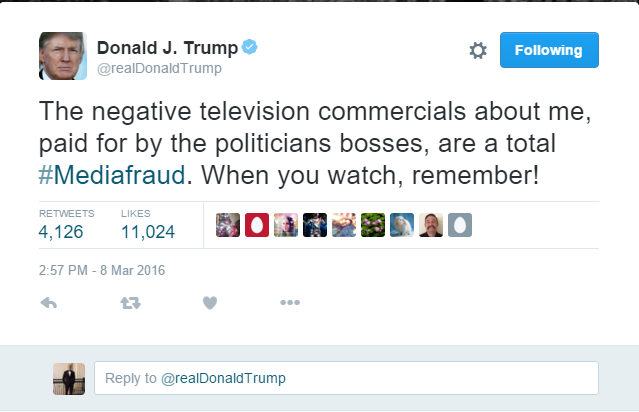
Donald Trump has always made "good" use of his twitter, promoting his "enthralling" personal thoughts and spotlighting his "razor-sharp insight" into politics, but this campaign season, he has outdone himself. There is something to be said for the impact of "Twitter storms." Consumers go on them constantly and are immediately contacted by the organizations they drag through the mud, offering steals and deals to try to make amends and stifle public, negative publicity. Trump has used his Twitter storms and account as both an entertainment outlet and a tool for his campaign. His attacks on other candidates, the media and his bolstering of his own accomplishments have drawn attention and even headlines. As we have discussed in a course which revolves around political communication, a candidate must be able to attract attention and spark discussion on social media, as well as in traditional media. Trump has done just that both with his "shocker statements" in person, recapturing some of that spotlight, but also with Twitter storms taking the wind out of less entertaining candidates' sails.

From Donald Trump Twitter


Potential downfall: In a general election against Hillary, how will Trump's Twitter foot stamping and name calling fair against Hillary's ability to get into the nitty-gritty on the issues?

#2 The Revolution Rhetoric: Bernie Sanders


How many time have we heard Bernie Sanders say the words "political revolution" and "top one percent" in his speeches, at debates, in interviews, and at rallies? While some see Sanders' focus on the issue he is most passionate about -- corporate greed, fixing income inequality, changing a corrupt campaign finance system, etc. -- as a weakness, calling him a one-issue candidate, his supporters see it as more of a brand. Sanders' brand through his rhetoric, whether critics will admit it or not, have propelled him to where he is now. Sanders, a self-proclaimed Democratic Socialist was expected to be laughed out of this primary election (much like another presidential candidate this season). Through a radical, revolutionary brand in his rhetoric, and the help of many, many Millennials in voting and spreading the word, Sanders has rocketed to several neck-and-neck state primaries with Hillary Clinton. His rhetorical brand of a government "truly for the people" has connected with many voters' anger with Washington and corporate America's greed (again, does this remind you of another candidate?). It cannot be denied that Bernie's brand is catching wind either -- even Hillary Clinton began borrowing some of his lines recently. Might Hillary be considering Bernie's brand, and might she be considering a Bernie VP to better her own stance in the eyes of Democratic Independents? We'll have to see.

Potential downfall: While his rhetoric is exciting, many see him as a one-issue candidate and his young voter following, while excited about him, doesn't turn out to polls in quite the number his campaign might hope.

#3 Kasich's Kindness

John Kasich has time and time again refused to "go negative" against other presidential candidates. Many feel that it is this choice that has doomed Kasich's campaign to fail from the beginning, but I'm not so sure. Kasich has taken the opposite approach of a Trump or, most recently, a Rubio this campaign season, attempting to show through his actions, not fighting words, that he is the candidate that can "get stuff done." As the race progressed, it became more and more obvious that Kasich wasn't a frontrunner, and, while he survived into the top four, he wasn't destined to be the next president, so why remain gentle, kind, patient Kasich? Kasich, too, is promoting a brand, but not with rhetoric; his is with non-verbal cues, actions, and choices. Kasich maintains a brand, still, of selling his product instead of commenting on why the others' are inferior. There have been inklings, however, that Kasich's brand is strategic. If Kasich does not take opportunities to attack candidates, even if the opportunity is handed to him, he remains a friend and is has been suggested that this may be his ploy for VP. The Ohio governor may be using his political communication skills as a sort of Jedi mind trick on voters, and instead, he may be focusing his energy on the frontrunners' right-hand seat.

Potential downfalls: Kasich continues to pull delegates away from the frontrunners and runs the risk of contributing to a Republican convention in which his VP dreams are slightly more cloudy.


Friday, March 4, 2016

Lessons on the campaign trail

By THOMAS HARTWELL

I am so incredibly excited to be in journalism, and my number one priority and my hope is that it shows while I'm on the job and in my finished product. As I've participated in gathering information and in reporting on the campaign trail, I have learned lessons, and sured-up others.
Bernie Sanders speaks at campaign rally at Morehouse College
in Atlanta, Tuesday, February 16. Photo by Thomas Hartwell
First lesson: the devil is in the details. I've learned this the hard way previously. The campaign events and news stories that I have covered have allowed me to build off of the mistakes that I've made. Accuracy is everything in journalism, and so is integrity -- accurate quotes and assurance of permission are paramount. During interviews, I write times of reference for good quotes, passionate answers, jokes, etc. on my recordings. I also have interviewees write their names and contact information on a notepad as well as record those elements on tape. For absolute assurance of friendly relations and a happy interviewee, I have made a habit of emailing soon after the interview thanking them and requesting a response which, in writing, displays my ability to use their photos, names etc. in my stories or blog posts (I have an archive full).

A man who preferred to be called "St. Nick" and his friend,
who preferred anonymity at the Morehouse College
 Bernie Sanders event, Tuesday, February 16.
Photo by Thomas Hartwell
On that same note, a lesson that I've learned throughout my life, but that has been reinforced in my reporting: don't take people and your interactions with them for granted. I love nothing more than meeting new people, asking them about the things they love or hot-button issues and participating in a sort of dialogue. Journalism allows for a relationship to develop very quickly and last between interviewer and interviewee -- it also provides opportunities for relationships to go South quickly, but we'll put that to the side for now. These relationships with both the people interviewed and people you simply run into have the potential to impact you in the moment and benefit you down the road.


"Look like you know what you're doing and nobody asks any questions." This is a lesson that I learned early and that I apply often. Check out the story.

My research lessons are simple: 1. Make note of everything relevant to your topic; even if you feel like you have way too much information, you'll be able to make some pretty cool connections that you wouldn't have otherwise realized. 2. If someone else knows more than you on a specific topic, LEARN FROM THEM. Political science wasn't something I was entirely interested in until recently, and I have learned SO MUCH simply from listening to my colleagues.

Gabriel Ramos stands atop the media platform at the
Morehouse College Bernie Sanders event, Tuesday,
February 16. Photo by Thomas Hartwell
It is becoming increasingly clear to me how exciting my career will be and how small the world of journalism really is. I have had an absolute blast on the trail with my colleagues, and I know that the excitement of, "You got that interview?" and "There's a great angle for a shot over there" will continue and manifest itself in important professional relationships in coming months and years. Whether or not my colleagues become competition in the future doesn't matter -- we'll all be working toward a commons goal: reliable, accurate and dependable reporting that, among other things, keeps the general public informed and the elites accountable. Final lesson: don't take your colleagues for granted -- your competition might just turn out to be your saving grace in the end.

Wednesday, March 2, 2016

What I've Learned

Oftentimes there exists within us preconceived notions. I had my own about what it meant for a candidate or their campaign to be positive or negative. One of the things I learned about research was that it can change those notions. In fact, to decide positivity or negativity, I had to quantify and quality those traits based on candidate’s website. I also learned that sometimes your source material is guaranteed to be permanent, and so you have to catch it while you can.

A screenshot of Gov. O'Malley's presidential campaign website
Another research lesson I learned is that it is important to pre-plan. It’s important to have more than just a notion of what you’re going to research, whether you’re collecting data off of a website, or conducting interviews, you want to have a thorough plan. Part of having a thorough plan is committing to meet in person with the people you are working with to work out and talk about what the group wants to do and how they want to do it in detail.


A little last minute practice and equipment-check
On the reporting side, things were interesting as well. I learned that you have to remember to get people’s emails when you email them, no matter who they are or what the situation is. It helps to validate and verify the source later on. The other lesson I’m still learning is that you just have to be able to approach people and try to talk to them. Some of them are going to say they don’t want to talk to you. They might not think you’re credentials are valid enough, or they just might not want their name in print or on the internet. But when you get that no, you just have to keep on going and go along to the next person and get the interviews you need.


And that's what I've learned the last 8 weeks in this course!