Showing posts with label THartwell Journalism. Show all posts

Wednesday, April 13, 2016

Confirmation bias in the media: Show me, tell me

By THOMAS HARTWELL

We, as humans, believe that we are inherently correct and seek out information that agrees with our thinking. How does this apply to our daily thinking or our consumption of products, services, and news?


Confirmation bias, or the interpreting of evidence or information in regards to existing beliefs, has been addressed often in the discussion of the presentation of news. Most believe that there should be no biases in news reporting, and journalists are taught to stay completely objective in the presentation of hard news. While, in a perfect world, consumers of news could watch/read news presented completely objectively and make educated decisions based on what they read, we do not live in a perfect world. News organizations have to incorporate what sells into the presentation of their stories. There is also a consideration of gatekeepers who run the media organizations. While the goal should always be objective reporting, people have a tendency to have strong opinions on political issues, which many times manifest themselves in subtle biases in reporting.

When we explore confirmation bias in the larger media outlets, we often encounter a widely-accepted thought pattern: "CNN and MSNBC are liberal, Fox is conservative." While this is now considered the norm, the media outlets themselves would never come out and admit to it. The media outlets, therefore, must disguise their biases as "just another way of reporting."

Let's look at Fox and MSNBC's reporting of the same story. A racially insensitive joke was told at a charity dinner recently, and both outlets wrote a story on it. Keeping in mind that Fox is considered conservative and MSNBC liberal, there is a subtle difference in the reporting in a couple ways:

Image and story from foxnews.com
Image and story from msnbc.com
1. The headlines: In Fox's case, the headline reads that both Mayor De Blasio and Hillary Clinton take part in the joke and draw criticism. If we consider Fox's possible confirmation bias, it would make sense that they would want to frame Hillary in this way. Whereas, in MSNBC's case, only De Blasio takes part in the joke, and even then it's presented as "coming at a bad time" rather than being "racially-tinged."

2. The visuals: Fox shows Clinton and De Blasio laughing and seemingly celebrating with the headline "racially-tinged joke" hovering above. It seems to be framed as the two enjoying the insensitive comment. MSNBC instead shows Clinton off to the side looking on as the joke is made. This way, she seems to not take part in the joke making. Clinton also is even standing next to the African-American gentleman, further separating herself from the insensitivity.

Images, as we've already seen, can speak a thousand words in reporting, and often do. The images we see can impact our impression of the candidate depicted. For these examples, I'll choose a picture of Ted Cruz from CNN and one from Fox.

Image result for cnn presidential race cruz
Image from cnn.com
Image result for cnn presidential race
Image from foxnews.com
In these cases, the presentation of Ted Cruz is considered in the photos chosen to be published on the sites. CNN's picture choice is less than flattering, while Fox's looks like a campaign flier.

While minds won't necessarily be changed by only images or word choice, the presentation of information or images can alter the way that people think about a subject. Objective news reporting and an educated public would be preferable to what is widely accepted as a biased news environment, but in order to inform the public, the public must want to be informed. If it takes subtle biases (even no-so-subtle ones) to inform them, then so be it -- I'll take the news with a grain of salt.


Wednesday, March 23, 2016

Framing the presidential race

By THOMAS HARTWELL

The presidential race in any context is a media frenzy, but this race has been unlike any before it in many ways. As with any story, the media make choices as to how to approach the stories surrounding the presidential race, and there are four commonly used "frames" of presentation, all of which have been used to cover the year's campaigns.

Horse Race:


Horse race journalism in the political spectrum is the presentation of information as a contest or comparison of, in this case, presidential candidates. There's been a lot of talk about a possible convention contest for the Republican nomination this campaign season, and that has opened the door for A LOT of horse race journalism. With a race this close between Trump and Cruz and a candidate pulling delegates away from the two front-runners, many outlets are taking the opportunity to present some "who will win the sprint to 1,237?" stories. There has been some in regard to the Democrats' race as well, but with a race on the left seemingly more and more decidedly won by Hillary, there have been more stories about the change that Sanders' campaign has brought to politics than "who will win?"
From the Associated Press
Conflict:

Horse race and conflict presentation of the Republican race have gone hand-in-hand this campaign season. As the race has continued and candidates have dropped out, there has been more opportunity for conflict-frame journalism. For instance, this CNN article incorporates elements of the delegate race, but describes the race for the nomination between Trump and Cruz as a "duel." A search for stories about Trump on CNN and other news outlets provides a look at the presentation of Trump's campaign strategy: conflict frame and a "Trump vs..." mentality. 

From cnn.com search

Issues:

Candidates of the same party and especially opposite parties LOVE to slam each other on policy issues -- the presidential race produces plenty of these opportunities. While most attacks come on an opponent's stance on ongoing issues, current events also play a part. For example, Trump and Cruz chose to slam President Obama on immigration regulations and international terrorism in response to terrorist attacks in Brussels, Tuesday. Stories written on the issues provide voters and onlookers with the ability -- hopefully objectively, but we all know, not so much -- to make decisions based on those issues. Trump has also generated lots of attention and media spotlight for himself by making large and outrageous issue claims. He's actually winning in the presidential race on lots of the "important issues," because he has so much coverage out there on his policy on those issues.

From msnbc.com
Candidate Attributes:

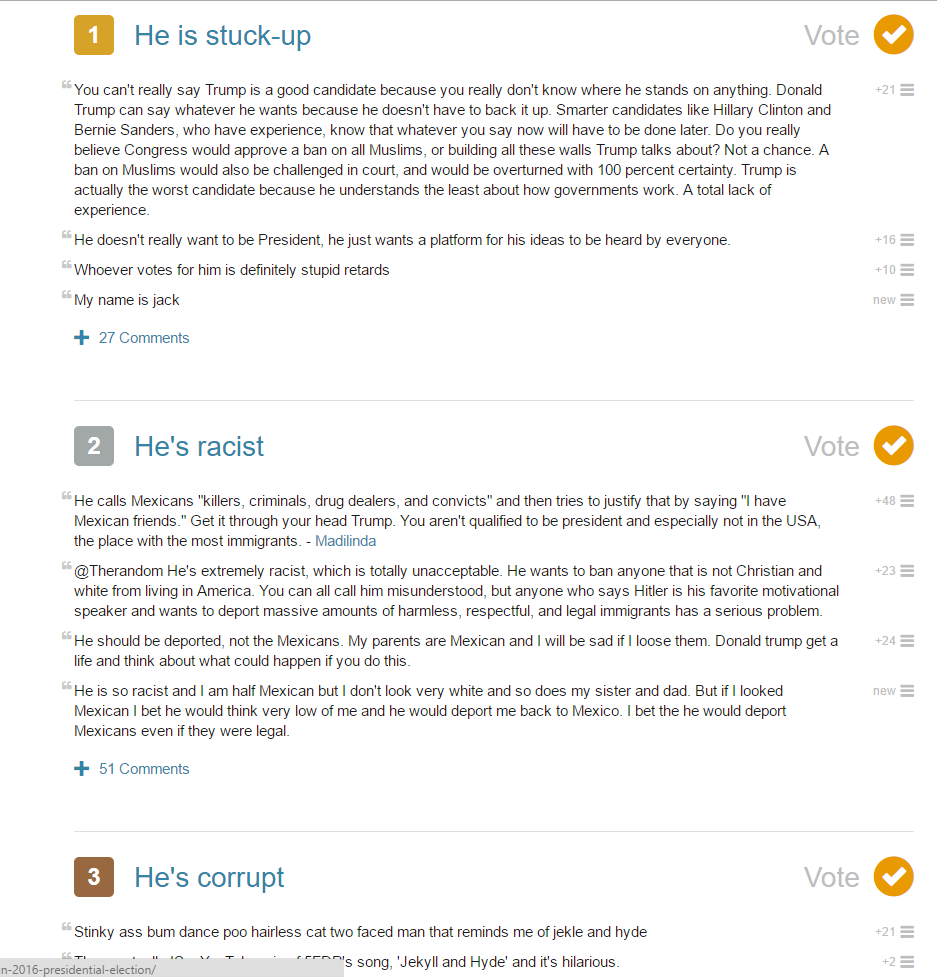
Another frame of media coverage dominated by Donald Trump and, some may argue, Bernie Sanders. Trump and Sanders' revolutionary approach to U.S. politics has changed the race for good, and a lot of that focuses on their personal attributes. Plenty of stories have focused on Trump's deficiencies, outlining why he couldn't, shouldn't or wouldn't be President of the United States.

From toptens.com
This article even outlines ten reasons why Donald Trump should not be the next president, citing his past words, actions, claims, etc. 

Tuesday, March 8, 2016

Twitter Tirades, Kasich Kindness and Revolution Rhetoric: The State of the Race 2016

By THOMAS HARTWELL

The 2016 presidential campaign has been underway for months, and various candidates have utilized various communication outlets and tactics to ensure voters that they are the best candidate for office. There are three themes that, over the entirety of the 2016 campaign season, have stuck out to me. These three themes and the candidates behind them have impressed me (whether or not I care to endorse them).

#1 Trump Twitter Tirades


From Donald Trump Twitter
Donald Trump has always made "good" use of his twitter, promoting his "enthralling" personal thoughts and spotlighting his "razor-sharp insight" into politics, but this campaign season, he has outdone himself. There is something to be said for the impact of "Twitter storms." Consumers go on them constantly and are immediately contacted by the organizations they drag through the mud, offering steals and deals to try to make amends and stifle public, negative publicity. Trump has used his Twitter storms and account as both an entertainment outlet and a tool for his campaign. His attacks on other candidates, the media and his bolstering of his own accomplishments have drawn attention and even headlines. As we have discussed in a course which revolves around political communication, a candidate must be able to attract attention and spark discussion on social media, as well as in traditional media. Trump has done just that both with his "shocker statements" in person, recapturing some of that spotlight, but also with Twitter storms taking the wind out of less entertaining candidates' sails.

From Donald Trump Twitter


Potential downfall: In a general election against Hillary, how will Trump's Twitter foot stamping and name calling fair against Hillary's ability to get into the nitty-gritty on the issues?

#2 The Revolution Rhetoric: Bernie Sanders


How many time have we heard Bernie Sanders say the words "political revolution" and "top one percent" in his speeches, at debates, in interviews, and at rallies? While some see Sanders' focus on the issue he is most passionate about -- corporate greed, fixing income inequality, changing a corrupt campaign finance system, etc. -- as a weakness, calling him a one-issue candidate, his supporters see it as more of a brand. Sanders' brand through his rhetoric, whether critics will admit it or not, have propelled him to where he is now. Sanders, a self-proclaimed Democratic Socialist was expected to be laughed out of this primary election (much like another presidential candidate this season). Through a radical, revolutionary brand in his rhetoric, and the help of many, many Millennials in voting and spreading the word, Sanders has rocketed to several neck-and-neck state primaries with Hillary Clinton. His rhetorical brand of a government "truly for the people" has connected with many voters' anger with Washington and corporate America's greed (again, does this remind you of another candidate?). It cannot be denied that Bernie's brand is catching wind either -- even Hillary Clinton began borrowing some of his lines recently. Might Hillary be considering Bernie's brand, and might she be considering a Bernie VP to better her own stance in the eyes of Democratic Independents? We'll have to see.

Potential downfall: While his rhetoric is exciting, many see him as a one-issue candidate and his young voter following, while excited about him, doesn't turn out to polls in quite the number his campaign might hope.

#3 Kasich's Kindness

John Kasich has time and time again refused to "go negative" against other presidential candidates. Many feel that it is this choice that has doomed Kasich's campaign to fail from the beginning, but I'm not so sure. Kasich has taken the opposite approach of a Trump or, most recently, a Rubio this campaign season, attempting to show through his actions, not fighting words, that he is the candidate that can "get stuff done." As the race progressed, it became more and more obvious that Kasich wasn't a frontrunner, and, while he survived into the top four, he wasn't destined to be the next president, so why remain gentle, kind, patient Kasich? Kasich, too, is promoting a brand, but not with rhetoric; his is with non-verbal cues, actions, and choices. Kasich maintains a brand, still, of selling his product instead of commenting on why the others' are inferior. There have been inklings, however, that Kasich's brand is strategic. If Kasich does not take opportunities to attack candidates, even if the opportunity is handed to him, he remains a friend and is has been suggested that this may be his ploy for VP. The Ohio governor may be using his political communication skills as a sort of Jedi mind trick on voters, and instead, he may be focusing his energy on the frontrunners' right-hand seat.

Potential downfalls: Kasich continues to pull delegates away from the frontrunners and runs the risk of contributing to a Republican convention in which his VP dreams are slightly more cloudy.


Friday, March 4, 2016

Lessons on the campaign trail

By THOMAS HARTWELL

I am so incredibly excited to be in journalism, and my number one priority and my hope is that it shows while I'm on the job and in my finished product. As I've participated in gathering information and in reporting on the campaign trail, I have learned lessons, and sured-up others.
Bernie Sanders speaks at campaign rally at Morehouse College
in Atlanta, Tuesday, February 16. Photo by Thomas Hartwell
First lesson: the devil is in the details. I've learned this the hard way previously. The campaign events and news stories that I have covered have allowed me to build off of the mistakes that I've made. Accuracy is everything in journalism, and so is integrity -- accurate quotes and assurance of permission are paramount. During interviews, I write times of reference for good quotes, passionate answers, jokes, etc. on my recordings. I also have interviewees write their names and contact information on a notepad as well as record those elements on tape. For absolute assurance of friendly relations and a happy interviewee, I have made a habit of emailing soon after the interview thanking them and requesting a response which, in writing, displays my ability to use their photos, names etc. in my stories or blog posts (I have an archive full).

A man who preferred to be called "St. Nick" and his friend,
who preferred anonymity at the Morehouse College
 Bernie Sanders event, Tuesday, February 16.
Photo by Thomas Hartwell
On that same note, a lesson that I've learned throughout my life, but that has been reinforced in my reporting: don't take people and your interactions with them for granted. I love nothing more than meeting new people, asking them about the things they love or hot-button issues and participating in a sort of dialogue. Journalism allows for a relationship to develop very quickly and last between interviewer and interviewee -- it also provides opportunities for relationships to go South quickly, but we'll put that to the side for now. These relationships with both the people interviewed and people you simply run into have the potential to impact you in the moment and benefit you down the road.


"Look like you know what you're doing and nobody asks any questions." This is a lesson that I learned early and that I apply often. Check out the story.

My research lessons are simple: 1. Make note of everything relevant to your topic; even if you feel like you have way too much information, you'll be able to make some pretty cool connections that you wouldn't have otherwise realized. 2. If someone else knows more than you on a specific topic, LEARN FROM THEM. Political science wasn't something I was entirely interested in until recently, and I have learned SO MUCH simply from listening to my colleagues.

Gabriel Ramos stands atop the media platform at the
Morehouse College Bernie Sanders event, Tuesday,
February 16. Photo by Thomas Hartwell
It is becoming increasingly clear to me how exciting my career will be and how small the world of journalism really is. I have had an absolute blast on the trail with my colleagues, and I know that the excitement of, "You got that interview?" and "There's a great angle for a shot over there" will continue and manifest itself in important professional relationships in coming months and years. Whether or not my colleagues become competition in the future doesn't matter -- we'll all be working toward a commons goal: reliable, accurate and dependable reporting that, among other things, keeps the general public informed and the elites accountable. Final lesson: don't take your colleagues for granted -- your competition might just turn out to be your saving grace in the end.