Showing posts with label 2016. Show all posts

Friday, March 11, 2016

Republican party aims to trump Trump as candidate furthers his delegate lead


By THOMAS HARTWELL, ESTI AFANADOR AND CHRISTIANI FERNANDEZ

The 2016 presidential campaign has been one that has, in many ways, strayed from the normal workings of U.S. elections, with the season’s rhetoric centered around the anger and distrust of a “corrupt Washington.” While both sides have seen revolutionary political strategies and several broken ballot records, the Republican party’s election has undeniably been the more colorful of the two, and Donald Trump has captured voters’ attention. The Republican race to the general election is narrowing, and the Trump campaign seems to be rallying the needed public support to face the Democrats in November.

“The Trump phenomenon – no one saw this coming. No one really understands why it’s happening – what’s going on – but I’ve got some ideas,” said political expert Kerwin Swint.

Swint is an author, speaker and professor of political science at Kennesaw State University. He has run campaigns, written books and his work has appeared in several national and international media outlets. Swint said that the “Trump phenomenon” as well as this campaign season’s obviously splintered GOP is something that has been in the cards for a while and has the potential to have lasting effects.

“What’s going on in the Republican party is a real revolution,” said Swint. “It is serious, it is dramatic, it is significant and it’s going to have long-term consequences.”
While there are plenty of voters out there who have voiced their discontent with Trump, more surprisingly, said Swint, is the amount of resistance Trump is receiving from the, so-called, establishment Republicans. The establishment fears that a Trump nomination means a Clinton victory, but it goes beyond that.
“The other part of their thinking … is, ‘Good Lord, he might win,’ which might be worse,” said Swint. “President Trump would pay no attention or very little attention to the establishment.”
Swint also said that a number of Republicans would rather see Clinton win the general election than Trump – a party line-crossing that has not been seen in decades.
Trump has appealed, most abundantly, to white, blue-collar workers who are tired of Washington and who are willing to cross party lines to vote an “outsider” into the Oval Office. His ability to pick up Independent votes has given him an edge in the delegate count, said Swint, but the damage that he and others have been doing to the GOP this season has forced some voters to display their unhappiness in other ways.

  
Delegate count in the 2016 presidential race so far, according to CNN.
If a candidate does not receive the shown majority of delegates (1,237),
the party goes to a convention, which nominates a candidate for the general
election. Source: http://www.cnn.com/election/ 
Zac Carr, a 25-year-old Cobb County voter said his primary vote was cast as a symbol of his own unhappiness with the candidates this campaign season.
“I voted for Rand Paul despite the fact that he is no longer running,” said Carr. “I asked for a non-partisan ballet because I, like George Washington, believe that the two-party system only polarizes our country. I wanted to do my part by showing that I believe non-partisan is preferred over Republican or Democrat.”

Carr said that the “nastiness” in the Republican race forced his hand and initiated his Independent vote.

Lott Middlemas, a Florida voter and international relations and Chinese double major at the University of South Carolina, agreed that the GOP race has been ugly, but said that its dirty tactics might be good for the number of voters in a general election.

“I think that voter turnout on both sides will increase noticeably for both parties as a result of the inflammatory politics of the Republican party during this election cycle,” said Middlemas. “The Republicans have been talking for years about expanding their base of support by appealing to minorities, but I don't think they'll see that as being necessary anymore since they've managed to draw out many more white voters than usual without having to soften their stances on economic and social issues that are often important to minority voters.”

The Democrats, said Middlemas, will turnout in larger numbers simply because of their fear of a Trump presidency and Clinton, he said, will beat Trump handily.

Not so fast, says Swint. A Clinton win isn’t such a sure-fire thing in a head-to-head.

“There are people assuming that Trump wouldn’t have a chance in a general election against Hillary Clinton. I’m not necessarily in agreement with that,” he said. “One of the strengths of Trump is that he’s put together a pretty broad coalition … It’s certainly not a slam dunk [for Clinton].”
It is his ability to appeal to groups of varying demographics and political opinion that potentially makes Trump dangerous, said Swint.
Yet another scenario in the Republican race is a nomination by a convention. Trump leads by about 100 delegates with 460, but he does have to get through a still very present Ted Cruz, and some wonder if the other Republican candidates may be able to pull enough delegates away from Trump to prevent his receiving a majority (1,237 delegates) and force the party to the convention. In this scenario, said Swint, the Republican leadership runs the risk, should they nominate someone other than Trump, of losing grip on their party.

“I think if they do take it away from [Trump] at the convention, I think he absolutely will run independent,” said Swint. “And I think at that point, he would be real interested in just wrecking the party for the Republicans.”
A non-Trump convention nominee would not only anger Republican voters, said Swint, but it would also cause “wheeling and dealing” between presidential candidates, state governments and others – precisely the kind of Washington antics voters are tired of.

According to Middlemas, though, Republican voters don’t need to worry about a convention.

“Super Tuesday cemented Donald Trump's supremacy in this race,” he said. “Sen. Cruz might be able to win a few more states, but Trump will certainly have a majority of delegates by the time the Republican national convention rolls around.”

Whether or not Trump has solidified his nomination remains to be seen, but polls with only Trump and Clinton’s name on them have begun to show up. Current CNN polls show either Democrat defeating Trump in November, but November is still miles down the road, said Swint.

“The general election [polls] right now are meaningless,” said Swint. “The election’s months and months away. We’re going to have coalitions, we’re going to have world events, we’re going to have economic developments that are going to affect that.”


All we can do now, said Swint, is wait and watch.

Tuesday, March 8, 2016

Twitter Tirades, Kasich Kindness and Revolution Rhetoric: The State of the Race 2016

By THOMAS HARTWELL

The 2016 presidential campaign has been underway for months, and various candidates have utilized various communication outlets and tactics to ensure voters that they are the best candidate for office. There are three themes that, over the entirety of the 2016 campaign season, have stuck out to me. These three themes and the candidates behind them have impressed me (whether or not I care to endorse them).

#1 Trump Twitter Tirades


From Donald Trump Twitter
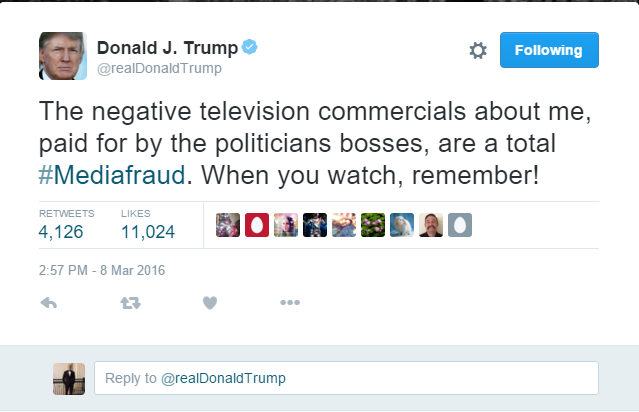
Donald Trump has always made "good" use of his twitter, promoting his "enthralling" personal thoughts and spotlighting his "razor-sharp insight" into politics, but this campaign season, he has outdone himself. There is something to be said for the impact of "Twitter storms." Consumers go on them constantly and are immediately contacted by the organizations they drag through the mud, offering steals and deals to try to make amends and stifle public, negative publicity. Trump has used his Twitter storms and account as both an entertainment outlet and a tool for his campaign. His attacks on other candidates, the media and his bolstering of his own accomplishments have drawn attention and even headlines. As we have discussed in a course which revolves around political communication, a candidate must be able to attract attention and spark discussion on social media, as well as in traditional media. Trump has done just that both with his "shocker statements" in person, recapturing some of that spotlight, but also with Twitter storms taking the wind out of less entertaining candidates' sails.

From Donald Trump Twitter


Potential downfall: In a general election against Hillary, how will Trump's Twitter foot stamping and name calling fair against Hillary's ability to get into the nitty-gritty on the issues?

#2 The Revolution Rhetoric: Bernie Sanders


How many time have we heard Bernie Sanders say the words "political revolution" and "top one percent" in his speeches, at debates, in interviews, and at rallies? While some see Sanders' focus on the issue he is most passionate about -- corporate greed, fixing income inequality, changing a corrupt campaign finance system, etc. -- as a weakness, calling him a one-issue candidate, his supporters see it as more of a brand. Sanders' brand through his rhetoric, whether critics will admit it or not, have propelled him to where he is now. Sanders, a self-proclaimed Democratic Socialist was expected to be laughed out of this primary election (much like another presidential candidate this season). Through a radical, revolutionary brand in his rhetoric, and the help of many, many Millennials in voting and spreading the word, Sanders has rocketed to several neck-and-neck state primaries with Hillary Clinton. His rhetorical brand of a government "truly for the people" has connected with many voters' anger with Washington and corporate America's greed (again, does this remind you of another candidate?). It cannot be denied that Bernie's brand is catching wind either -- even Hillary Clinton began borrowing some of his lines recently. Might Hillary be considering Bernie's brand, and might she be considering a Bernie VP to better her own stance in the eyes of Democratic Independents? We'll have to see.

Potential downfall: While his rhetoric is exciting, many see him as a one-issue candidate and his young voter following, while excited about him, doesn't turn out to polls in quite the number his campaign might hope.

#3 Kasich's Kindness

John Kasich has time and time again refused to "go negative" against other presidential candidates. Many feel that it is this choice that has doomed Kasich's campaign to fail from the beginning, but I'm not so sure. Kasich has taken the opposite approach of a Trump or, most recently, a Rubio this campaign season, attempting to show through his actions, not fighting words, that he is the candidate that can "get stuff done." As the race progressed, it became more and more obvious that Kasich wasn't a frontrunner, and, while he survived into the top four, he wasn't destined to be the next president, so why remain gentle, kind, patient Kasich? Kasich, too, is promoting a brand, but not with rhetoric; his is with non-verbal cues, actions, and choices. Kasich maintains a brand, still, of selling his product instead of commenting on why the others' are inferior. There have been inklings, however, that Kasich's brand is strategic. If Kasich does not take opportunities to attack candidates, even if the opportunity is handed to him, he remains a friend and is has been suggested that this may be his ploy for VP. The Ohio governor may be using his political communication skills as a sort of Jedi mind trick on voters, and instead, he may be focusing his energy on the frontrunners' right-hand seat.

Potential downfalls: Kasich continues to pull delegates away from the frontrunners and runs the risk of contributing to a Republican convention in which his VP dreams are slightly more cloudy.


Sunday, January 24, 2016

Rick Santorum's use of ads and Facebook

Rick Santorum has attempted four very distinct ad campaigns.

My count has Santorum with five ads; two are attack ads against former Secretary of State Hillary Clinton, one is aimed at Senator Rand Paul and former Governor Mike Huckabee simultaneously and one is addressed at Senator Ted Cruz.


None of the ads are targeted against Republican front-runner mainstay Donald Trump. In fact, in one debate Santorum insisted that personal attacks amongst Republicans only helped Hillary Clinton.


In his latest ad, released on January 20th Santorum implored that voters join him so that together they may, “… take back America from the Left, the special interests and the DC Establishment!”

Santorum uses his Facebook mostly to chronicle his journey through Iowa and New Hampshire. Occasionally a letter to the editor from the Union Leader or an interview on Fox News Radio is shared along with the occasional video from C-SPAN, but mostly the Senator seems to want folks to know that he’s working hard in the early states to earn votes. The other important component of Santorum’s Facebook is the repetitive posting of his victory over partial birth abortions. As a part of that Santorum includes pictures of him and his family holding up pieces of paper, all with different statements written on them, but all with the hashtag #WhyWeMarch.

The two rhetorical appeals Santorum uses most often are accumulation and antithesis. Santorum said in one debate, “We’re a country of laws, Bill. A country of laws, not of men […] But the reason America’s a great country, the reason is because our compassion’s in our laws.”

Accumulation has not worked for Santorum to persuade or mobilize voters as evidenced by his place in undercard debates and his sustained low poll numbers (His highest polling in the 2016 cycle was 11%).

Sunday, January 17, 2016

A Look at Governor Jim Gilmore's Campaign Communication Strategies

PHOTO CREDIT: Michael Vadon
Gilmore was governor of Virginia from 1998-2002
PHOTO CREDIT: Michael Vadon
The Wikipedia page, “Jim Gilmore presidential campaign, 2016” concludes with the sentence, “On October 30, 2015, Jim Gilmore was verified on Twitter.”

This seemingly mundane information suggests the importance of social media in campaigns for president. A verified Twitter page lends assurance to the media when covering a candidate, such as Gilmore.

The communication apparatus of Gilmore’s campaign is questionable at best. He has seven videos on C-SPAN for the entire year of 2015, has only been in one debate, and is sometimes left out of polls altogether.

Gilmore used a video to announce his campaign. The video shows him sitting in front of a bookcase (and a picture of George Washington) in a blue button down shirt. The Gilmore campaign did not hold an event (press conference or rally) for the governor’s announcement.

The campaign seems to only have two paid consultant, Boyd Marcus and Dan Kreske. While Marcus has a history with Gilmore, there is nothing to suggest he is a communication specialist.

Kreske, similarly, has a history with Gilmore, but no notable history in communication.

In a campaign cycle that’s embracing Snapchat, Gilmore has kept his social media strategy simple. He has Facebook and Twitter.

The Gilmore website includes amongst its headers a ‘VA Petition’ to get the governor on the ballot in Virginia, the state Gilmore is a former governor of. The ‘News’ feature of the Gilmore website may be the most effective tool the Gilmore campaign uses, given that anyone reads it.

The news section of his website and recent posts on Facebook show Gilmore campaigning in Florida, but the ‘Photo Galleries’ on the website only have links for ‘New Hampshire’, ‘South Carolina’ and ‘Virginia’.


The photo gallery for New Hampshire shows that Gilmore, like other governors, is focusing on the Granite State over others.